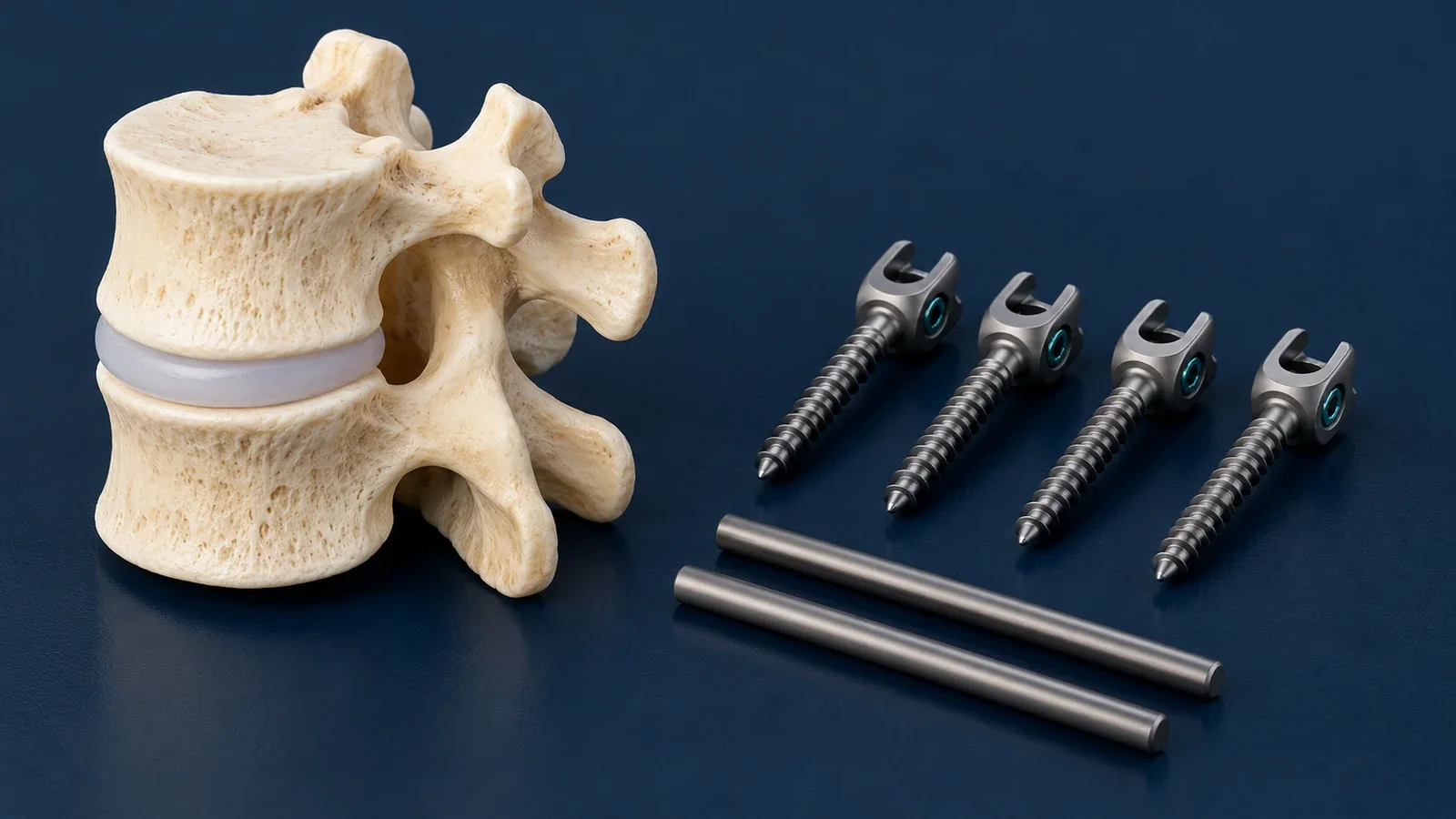
What are spinal stabilisation and fusion?
Spinal stabilisation means surgical support intended to control unwanted movement or structural instability in a particular spinal region. Screws, rods, plates or spacers may be used. Spinal fusion aims to create bony union between two or more vertebrae. These concepts are related but do not describe exactly the same procedure.
Instrumentation describes the surgical support systems used. Placing a support system and completing biological bony union are different stages. Fusion takes time and requires follow-up. Implants or fusion are not necessary for every spinal disease. The diagnosis and the problem stabilisation is intended to address should first be explained.[1]
When might it be considered?
Stabilisation may be considered for instability, certain slippages and deformities, particular fractures or support needs created by surgical extent. These examples alone are not surgical criteria. Disease characteristics, neurological findings, pain and functional loss are assessed together. The same diagnostic name may involve different surgical needs.
Does lumbar slippage always require fusion?
Degenerative lumbar spondylolisthesis does not require the same operation for everyone. Its clinical significance, relationship to stenosis, movement and symptoms are assessed. Some people may be considered for decompression alone, while others may require stabilisation. The findings supporting the decision should be explained specifically.
The everyday phrase putting screws in does not adequately describe operative aims or scope. How many levels, which support and why fusion is considered are separate questions. Patients can ask each individually. More material does not automatically mean more suitable treatment.
What assessment is needed for planning?
Assessment covers symptom onset, walking and everyday changes, previous operations and treatments. Neurological examination reviews strength, sensation and reflexes. MRI, CT or other appropriate images are chosen according to the clinical question. Movement-related spinal features may sometimes need further investigation; not every test is used for everyone.
Bone quality and general health may matter for support selection and recovery. Diabetes, nutritional problems, smoking or nicotine and regular medicines are discussed. This information affects preparation and follow-up as well as operability. A standard operative timetable should not be fixed before individual assessment is complete.
What does stabilisation surgery aim to achieve?
Support is used to maintain vertebral relationships or assist appropriate alignment at planned levels. Coexisting nerve compression may require decompression too. These procedures have distinct aims: one creates space for nerve tissue, the other addresses mechanical spinal circumstances. Components depend on individual needs.
Bone grafts and spacers
Bone graft or suitable graft materials may help fusion develop. Some techniques place a spacer in the disc space. The approach depends on the region and structural problem. A brand or material name does not establish superiority. Patients can ask which support is proposed and why.
Anterior, posterior or other access routes may be considered in selected patients. An approach's name does not imply the same benefit-risk balance for everyone. Previous scars, bone and surrounding tissues can influence planning. This text explains the decision framework rather than providing technical operative training.
Research comparing fusion with decompression
The five-year randomised Nordsten-DS follow-up compared decompression alone with additional instrumented fusion in selected patients with degenerative slippage and stenosis. It helps assess why fusion is not compulsory in every case within that population. Applying results to traumatic instability, substantially different deformities or every spinal operation is inappropriate.[2]
Function, pain and repeat operations have different meanings when research compares surgical groups. A group result does not determine which method one individual should receive. Research is combined with clinical characteristics. The reasons for recommending surgery and rejecting more limited options should both be explained.
Could non-surgical or more limited options be suitable?
Depending on the disease, monitoring, activity modification, suitable medicines and rehabilitation may be considered. Some people may be candidates for decompression alone or procedures of different scope. However, not every structural problem can be managed identically without surgery. Alternative suitability is assessed alongside neurological and mechanical findings.
The discussion can cover possible consequences of waiting and new findings that would change the plan. Age or material name alone is not decisive. Everyday priorities, expected movement changes and surgical burden also matter. Another opinion may form part of individual decision-making when needed.
Possible complications and uncertainties
Assessment covers infection, bleeding, nerve injury, cerebrospinal fluid leakage and clot-related problems. Non-union, implant loosening or breakage, persistent symptoms and repeat intervention are also possible. Other risks specific to the region and access route should be discussed. Their personal significance depends on patient characteristics.[1]
Changes may develop next to the operated level over time. They do not necessarily cause symptoms or require another operation in everyone. Implant appearance on imaging and the person's symptoms are different findings. Follow-up combines mechanical, neurological and functional assessment.
Preparation, bone health and everyday life
Smoking and nicotine may adversely affect bone healing, so the surgical team may advise preparation in this area. An individual cessation plan and suitable support should be discussed. Nutrition, bone health and management of coexisting conditions also matter. No vitamin or supplement should be assumed necessary for every patient.[3]
Discuss assistance with early household tasks, stairs and transport in advance. Report regular medicines, blood thinners and allergies. Medication adjustments should follow the healthcare team's plan. Old preparation instructions for another operation should not be reused automatically.
How is follow-up after fusion organised?
Reviews assess wound healing, neurological status, pain and everyday movement. Imaging may examine support systems and bony union where needed. Recovery is not determined by the calendar alone. Workload and operated levels influence advice on work and physical activity.
New weakness, impaired bladder control, fever, wound discharge or sudden breathlessness require prompt assessment at a healthcare facility. Patients should be told which symptoms need emergency help. Long-term review and exercise follow individual needs; general online timetables do not replace the plan.
Points to clarify during the consultation
Which levels and which goals?
You can ask how planned levels relate to symptoms, why decompression is needed and the rationale for fusion. Movement effects can be discussed in relation to work and daily activities. Material function and expected biological union should be explained separately. Unclear terms can be explained again.
What should you know about implants?
Will the support system be removed later?
Screws and rods do not routinely need removing in everyone. Later management depends on the system's purpose and the person's condition. Suspected implant problems require assessing symptoms and images together. The presence of material alone does not justify another operation.
Keep operative documents, implant details and review records. They help another hospital understand previous intervention scope. New pain should not automatically be attributed to an implant; other causes may require assessment.
Personal goals can change over time. Changes in work, independent movement or care needs should be raised at review. Disease-related disability, mechanical surgical aims and rehabilitation goals can be explained separately. Follow-up then extends beyond reviewing an imaging report alone.
Spinal stabilisation assessment in İzmir
Assessment for spinal stabilisation and fusion considers old images, operative records and current functional loss together. Op. Dr. Ozan Ganiüsmen's İzmir practice details are on the contact page. This article is not an individual surgical recommendation; technique and support needs require personal assessment.
Scientific and Institutional Sources
- RNOH NHS — A Patient’s Guide to Low Back Fusion Surgery
Institutional patient information; fusion, implants and individual planning
- Nordsten-DS — Decompression alone or with fusion for degenerative lumbar spondylolisthesis: five year follow-up
Randomised comparison limited to degenerative slippage and stenosis; not generalised to other instability
- Northern Care Alliance NHS — Spinal fixation surgery: physiotherapy advice
Institutional patient information; healing and individual follow-up; no standard exercise timetable reproduced