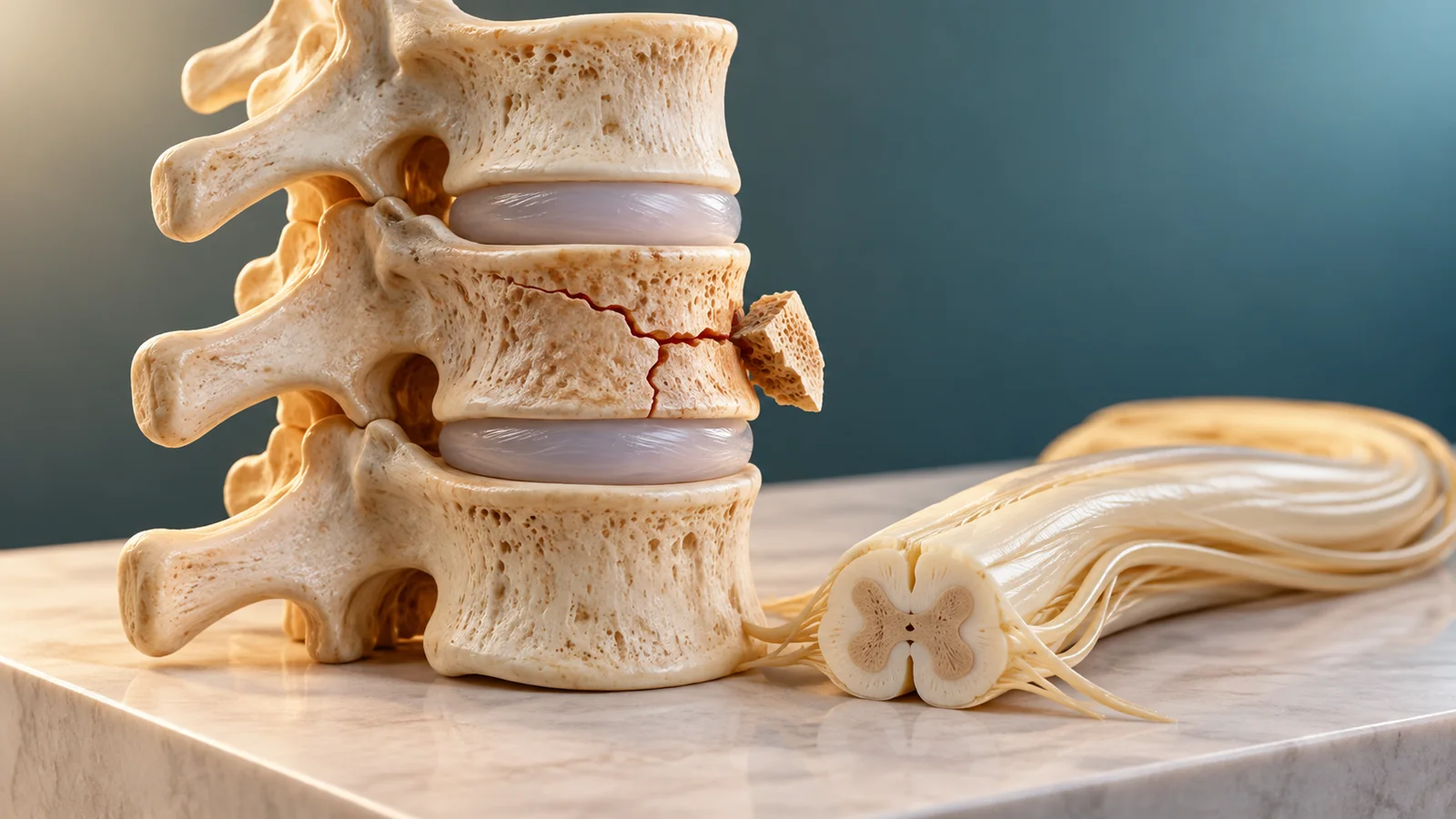
The spine and spinal cord are different structures
Distinguishing bone injury from nerve injury
A spinal injury may affect vertebrae, discs and ligaments. Spinal cord injury damages tissue carrying nerve signals between brain and body. Not every vertebral fracture injures the cord; cord injury can also occur without an obvious fracture. Traffic collisions, falls, sport and other trauma may be responsible. Effects differ between neck, thoracic and lumbar injuries. Compression, instability and associated injuries are assessed together. Complete and incomplete cord injuries are distinguished clinically; complete does not necessarily mean physical separation of the cord. Early findings do not entirely determine the later course. Symptoms, repeated examinations and imaging require joint interpretation. Emergency care aims to prevent further injury and preserve life-supporting functions, while acknowledging uncertainty about subsequent recovery.[1][2][3][4]
Long-term reviews also consider relatives' care burden and education needs. Social support, accessible housing and individualised aids can form part of care. Reassess these needs as circumstances change.
Warning signs and initial response
Avoid unnecessary movement
After trauma, neck or back pain may accompany weakness, numbness, sensory loss or difficulty walking. Inability to pass urine, altered bladder or bowel control and genital numbness matter. Severe cervical injury may affect breathing. With suspected spinal cord injury, call 112 in Türkiye. Do not force the person to stand or move the spine unnecessarily. Airway safety takes priority; trained teams handle transport and immobilisation. Absence of reported pain is not reassurance in someone unconscious or unable to communicate. Other major injuries do not remove the need for spinal assessment. Report medicines, earlier spinal disease and previous mobility. Do not improvise vehicle extraction or attempts to straighten the neck unless a life-threatening necessity requires action. Communicate observed changes to the emergency team.[1][2][3]
Examination and imaging
Assess stability and nerve function together
Teams assess breathing, circulation and other injuries. Strength, sensation and relevant neurological findings help establish injury level and completeness. CT shows bone injury; MRI assesses cord, discs, ligaments and soft tissues. Selection depends on age, mechanism and clinical findings. Spinal stability describes the ability to protect nerves under normal loads. A small-looking fracture is not necessarily stable. An identified injury may prompt examination of other levels according to context. Initial examination may be limited by pain, awareness or other injuries and require repetition. Previous movement restrictions and neurological problems need distinguishing from new damage. Reports must be interpreted within the whole clinical picture by specialists. Images alone do not replace reassessment when symptoms or neurological findings change during observation.[1][2][3]
Non-operative care
Protection, support and preventing complications
Selected stable fractures may be managed with a brace or collar, pain relief and clinical and imaging follow-up. Device type and duration are individual; patients should not independently change rigidity or use. Cord injury also requires management of breathing, circulation, bladder and bowel function. Preventing pressure sores, lung complications and venous clots matters. Nutrition and early rehabilitation planning are part of care; intensive care may be needed. Medicines and support reflect the individual condition. Treatments claimed to restore cord function should not be recommended without assessing evidence and suitability. Patients and relatives need to understand care goals. Education about positioning, skin care and safe transfers can reduce long-term complications and should follow individual specialist advice, with practical instructions adapted to actual care needs.[1][2][3][4]
When is surgery considered?
Relieving compression and stabilising the spine
Continuing nerve compression, unstable fracture or dislocation and progressive neurological loss can prompt surgical assessment. Removing compressive structures and stabilising the spine with screws, rods or suitable systems may be aims. Not every fracture requires surgery, and surgery cannot always reverse existing nerve damage. Timing reflects general health, other injuries, images and specialist assessment. Evidence about timing is not equally strong for all populations; one universal hourly rule is inappropriate. Risks include bleeding, infection, new neurological loss, cerebrospinal fluid leakage, implant problems and repeat surgery. Explain whether the aim is decompression, stability or both. Benefits and limits need discussion alongside present function and life goals. Achieving stable bone alignment does not by itself establish how much neurological recovery will follow.[1][2][5]
Long-term follow-up
Continuity of rehabilitation in İzmir
Monitor movement, sensation, pain and spinal alignment. With cord injury, bladder, bowel, skin and circulatory care remain important. Rehabilitation can address independent transfers, aids, home adaptations and work participation. Rate and extent of improvement vary; walking or complete recovery cannot be promised. New weakness, increasing numbness or sudden bladder changes need reassessment. Breathing difficulty or severe acute symptoms require emergency help. Bring trauma images, operation reports, rehabilitation records and medicine lists to Op. Dr. Ozan Ganiüsmen in İzmir. Follow-up may involve a trauma centre, spinal team and rehabilitation specialists. The patient's priorities belong in discussion. Care aims beyond fracture healing to safety, comfort and achievable independence, with ongoing support needs reviewed as abilities and circumstances change. Practical difficulties should be described as clearly as possible during consultations.[1][2][3][4]
Scientific and Institutional Sources
- NICE NG41 — Spinal injury: assessment and initial management
Assessment of traumatic spinal and spinal cord injuries
- AANS — Spinal Cord Injury
Complete and incomplete injuries; diagnosis and treatment
- NINDS — Spinal Cord Injury
Nerve signalling, impairment and rehabilitation
- NICHD — Spinal Cord Injury
Relationship between spinal damage and cord involvement
- AANS/CNS — Position statement on acute spinal cord injury guidelines
Limits of surgical timing evidence; no universal hourly rule reproduced