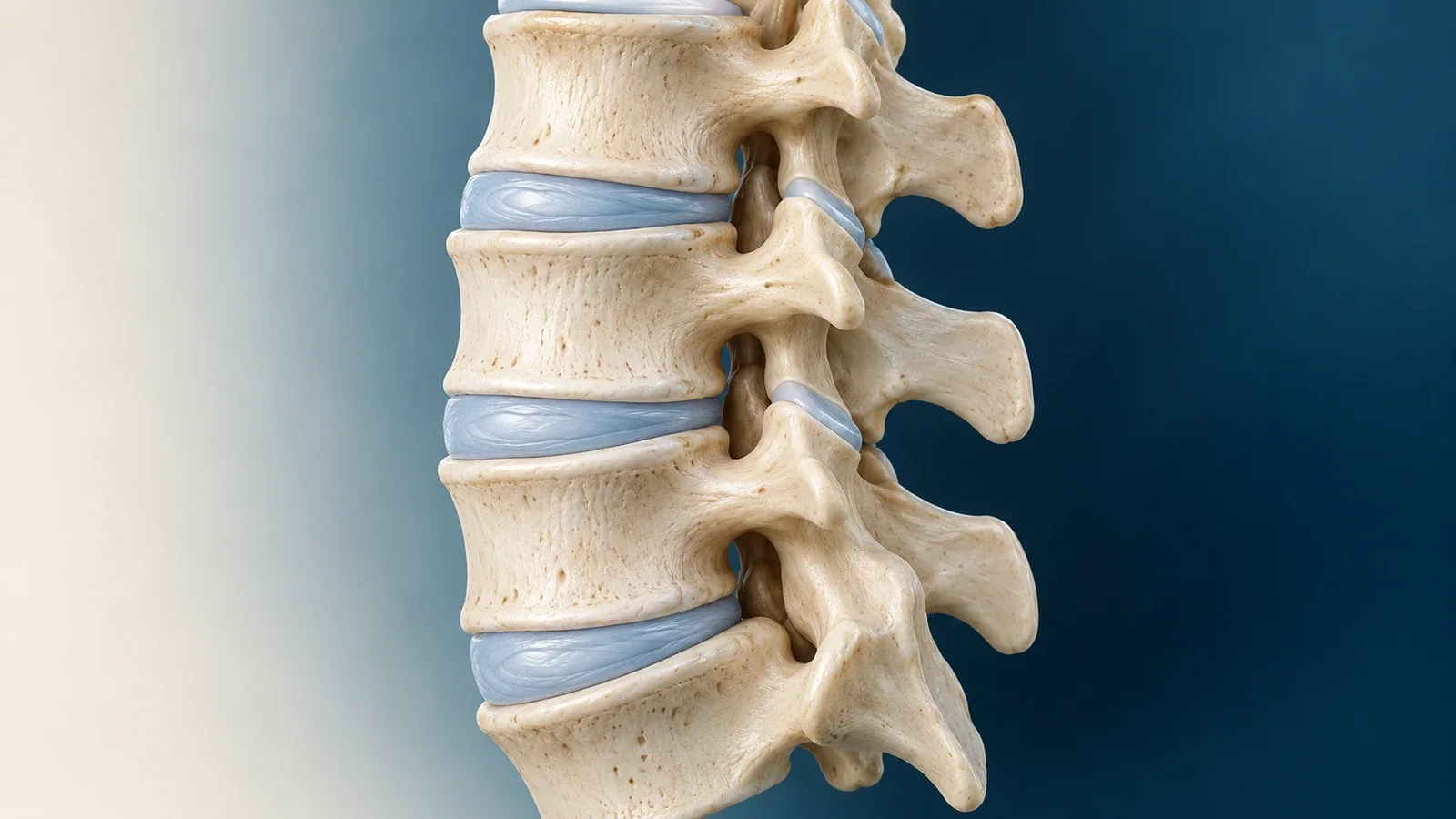
What is a lumbar disc herniation?
A lumbar disc herniation occurs when part of a disc between the lower back vertebrae moves beyond its normal boundaries. The outer ring and inner structure of the disc together contribute to spinal movement and load distribution. When displaced tissue affects a nearby nerve root, pain radiating into the leg, numbness or reduced muscle strength may occur. However, finding a disc change on imaging does not mean that it explains every symptom.
Low back pain and a lumbar disc herniation are not the same thing. Muscles, joints and other structures can also cause pain. Some people have appearances consistent with a herniated disc on MRI without significant symptoms. Assessment therefore considers symptoms and the neurological examination together, rather than relying on the name given to an imaging finding.
What symptoms can a lumbar disc herniation cause?
Radiating leg pain and changes in sensation
Nerve root involvement can cause pain extending from the lower back through the buttock into part of the leg. Tingling, burning or numbness may accompany it. The distribution provides clues about which nerve may be involved, but trying to identify the nerve level yourself is not a reliable diagnostic method. The side, distribution and response to movement are assessed together during examination.
Why weakness matters
Difficulty climbing stairs, lifting the front of the foot or changes in walking are also discussed. Avoiding movement because of pain and a true loss of muscle strength may be different problems. A neurological examination helps distinguish them. New or progressively worsening weakness is not a symptom that should simply be managed by taking painkillers and waiting.
Which symptoms require urgent assessment?
Difficulty starting urination or new loss of bladder control, loss of bowel control, new numbness around the genitals or the area used for sitting, and marked leg weakness can be important warning signs, whether they occur together or separately. They can arise for different reasons, including serious involvement of nerves within the spinal canal. Assessment in an emergency department is required rather than waiting for a routine appointment.[1]
Pain beginning after significant trauma, pronounced lower back symptoms with fever, or a deterioration in general health should also be assessed promptly. Tell the physician about a previous cancer diagnosis or unexplained weight loss. None of these signs alone establishes a particular diagnosis; their importance is that other conditions may need investigation. In a sudden, serious health emergency in Türkiye, call 112 for emergency assistance.
How are the examination and investigations assessed?
The consultation covers when symptoms began, the relationship between leg and back pain, previous episodes and the effects on daily life. Examination may include muscle strength, sensation, reflexes and walking. Examination techniques such as moving the leg in a particular way may also contribute. No single movement or test has the same meaning in every patient.
Is an MRI always needed immediately?
MRI is one investigation used to assess discs and structures related to nerves. However, immediate imaging is not essential for every new episode of low back pain. The need depends on examination findings, the course of symptoms and any urgent warning signs. Reviewing the actual images from a previous MRI, as well as its report, can be helpful. Investigations are selected individually.[2]
CT, plain radiographs or electromyography (EMG) can provide additional information in some circumstances. They are not directly interchangeable. For example, further investigation may be considered if nerve compression at another location is suspected. Having several tests does not, by itself, mean that the diagnosis is more detailed or more accurate.
What non-surgical treatment options are considered?
For many people without an urgent neurological problem, non-surgical options are considered at the initial assessment. These may include pain management, maintaining movement that the person can tolerate and an appropriate rehabilitation plan. Medication is considered alongside other conditions, allergies, kidney and stomach problems, possible pregnancy and other medicines. This information is not a recommendation for a particular medicine or dose.
Movement and exercise
Instead of prolonged inactivity, an activity level suited to the individual is discussed. Which movements are appropriate depends on the nature of the pain and examination findings. An exercise found online should not be assumed suitable for everyone. If new weakness, a marked increase in numbness or another neurological change develops during exercise, the assessment plan needs to be reconsidered.
Although procedures such as injections may be considered for some patients, the same intervention is not required for every herniated disc. Radiofrequency treatment directed at a facet joint and treatment of nerve compression caused by disc tissue are different approaches. Hearing a treatment name frequently does not establish that a person is a suitable candidate.
When is lumbar disc surgery considered?
Surgical assessment considers symptom severity and duration, response to non-surgical approaches, signs of nerve involvement and their agreement with imaging findings. Progressive weakness or signs of urgent nerve compression can change the timing of a decision. In other circumstances, options, expected benefits and risks are discussed with the patient. A report describing a large herniation does not, on its own, mean that surgery is needed.
With procedures such as microdiscectomy, the aim in selected patients is to remove the part of the disc contributing to pressure on a nerve. The same technique is not used in every operation; the approach may depend on the location of the herniation and associated structural problems. The effect on back pain alone should not be assumed identical to the effect on nerve-related leg pain.
A randomised study by Peul and colleagues compared early surgery with prolonged conservative treatment in selected patients with persistent sciatica. It illustrates that the speed of early improvement and longer-term outcomes are different questions. It does not mean that every patient should have surgery after the same period.[3]
Why are risks and follow-up important?
When surgery is considered, possible infection, bleeding, nerve injury, cerebrospinal fluid leakage, persistent symptoms and recurrent disc herniation are discussed. The level of risk can vary with the person and procedure. Applying a general percentage as an individual outcome prediction without knowing the patient's age, conditions and planned approach is inappropriate.
Follow-up considers strength, sensation, walking and daily function as well as pain. There is no single timetable for returning to work, driving and exercise that applies to everyone. In particular, new neurological symptoms, fever or wound problems after surgery should be reported to the healthcare team without waiting for the scheduled review.
Frequently asked questions
Does every lumbar disc herniation require surgery?
No. Decisions depend on symptoms, neurological findings, agreement with investigations and the course of the condition. Non-surgical options are sufficient for some people, while others need surgical assessment. This distinction cannot be made from an online article.
What does it mean if an MRI reports several herniated discs?
Disc changes can occur at several levels. Examination and images are considered together to identify the level related to symptoms. It should not be assumed that every finding listed in a report requires a separate procedure.
What can I prepare for an assessment in Izmir?
You can prepare previous MRI and CT images, reports, a medication list and a short note describing how symptoms have changed. The contact page provides the address of Op. Dr. Ozan Ganiüsmen’s practice in Alsancak. The purpose of the consultation is to assess the cause of back and leg symptoms and explain options suited to the individual.
How can changes in symptoms be monitored?
Back and leg symptoms may not be identical from day to day. Pain after a particular movement and progressively worsening weakness are assessed separately. Brief notes can cover the location of pain, daily function and new symptoms. There is no need to repeatedly test your own muscle strength or deliberately provoke pain; the necessary assessment is performed during examination.
At follow-up, explaining which treatments have been tried, for how long and what has changed in daily life may be useful. Imaging appearances and symptom severity do not always change together. The need for new imaging is not determined solely by one day of increased pain. However, new neurological changes mean that the previously agreed follow-up plan should be reconsidered. Individual advice should not be replaced with another patient's timetable or an experience shared on social media.
Scientific and Institutional Sources
- NHS — Slipped disc
Institutional patient information on urgent signs and the general condition
- AANS — Herniated Disc
Professional association patient information on assessment, investigations and treatment options
- Peul et al. — Surgery versus prolonged conservative treatment for sciatica
Randomised clinical research on surgical and non-surgical strategies in selected patients with sciatica