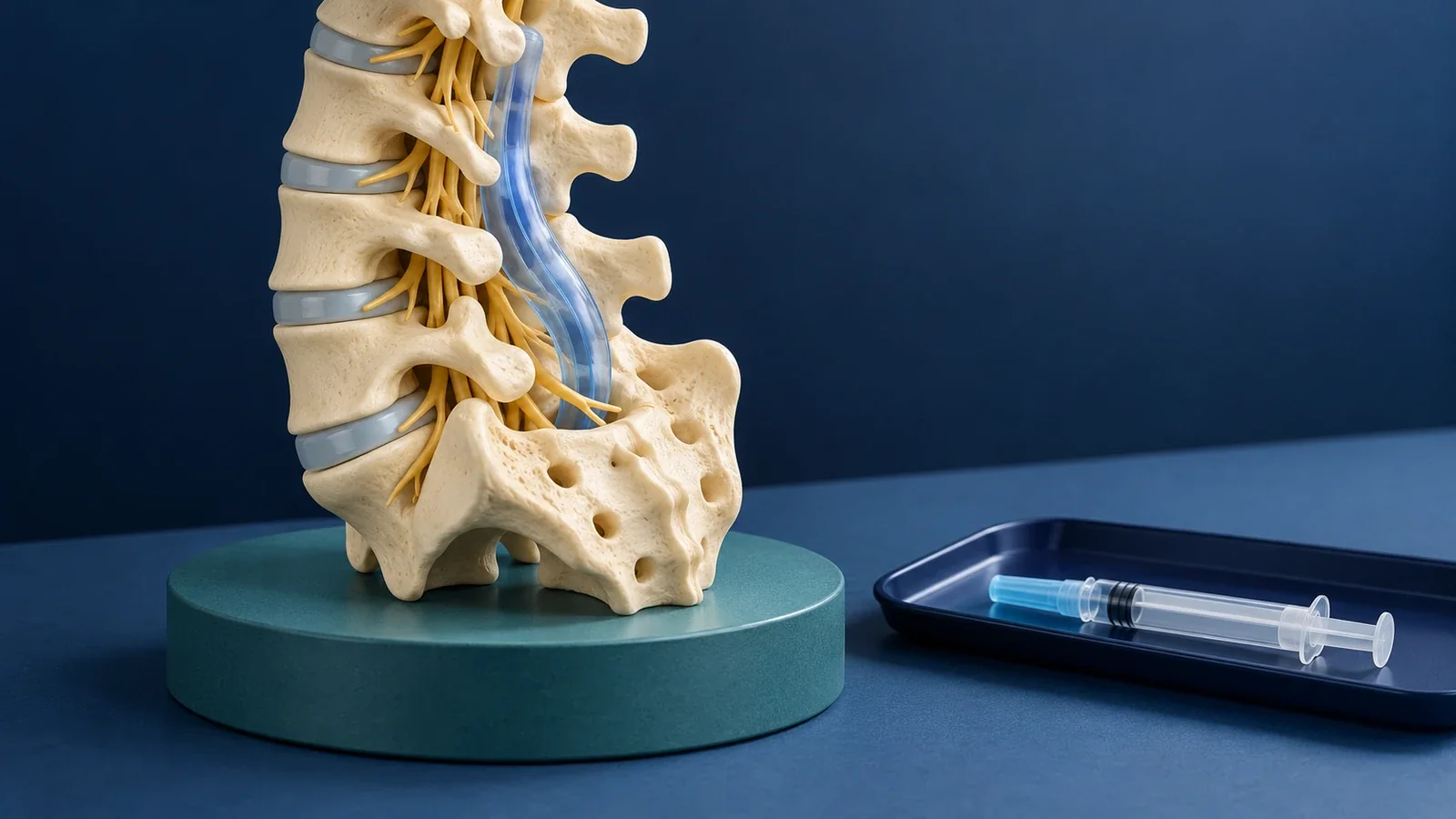
What is an epidural injection?
An epidural injection delivers medicine into the epidural space outside the membranes surrounding the spinal cord and nerves. Pain treatment injections and epidural anaesthesia in childbirth have different purposes. A pain procedure aims to help reduce inflammation-related symptoms around nerve roots in selected patients. It does not surgically remove a herniated disc, reconstruct the spine or suit every lower back pain.[1]
Understanding the symptom being targeted matters as much as learning the method's name. Radiating nerve root leg pain and pain confined to the lower back are assessed differently. Disc changes on MRI alone do not justify injection. Distribution, neurological examination, daily impact and previous care are considered together. Intended benefit and limitations should be explained individually.
When might it be considered?
Sciatica and nerve root symptoms
Irritation associated with lumbar disc herniation can cause pain radiating from the back into a leg, sometimes with numbness or tingling. NICE recommends considering epidural local anaesthetic and steroid for acute severe sciatica. This does not mean every herniation should be injected. The same guidance does not recommend routine spinal injections for lower back pain alone.[2]
Symptoms associated with stenosis
Leg symptoms on walking due to spinal stenosis form a different clinical picture. Assessment depends on details such as narrowing level and symptom pattern. NICE does not recommend epidural injection for neurogenic claudication due to central canal stenosis. Findings should not be transferred between different disease groups. Spinal cord involvement, progressive weakness or other important neurological findings mean an injection cannot replace necessary surgical assessment.[2]
How should scientific evidence be interpreted?
The American Academy of Neurology's 2025 systematic review assessed epidural steroids separately for cervical and lumbar radiculopathy and stenosis. Findings suggest limited short-term pain and functional benefit for some radiculopathy patients. Long-term pain outcomes remain uncertain. The intervention should therefore not be described as providing permanent recovery or proven elimination of surgical need.[3]
Easier movement after an epidural steroid injection may help participation in rehabilitation. Relief may nevertheless be absent or temporary. Value is not measured only by pain scores: walking, sleep, work participation and daily function also matter. Recording changes helps determine the next step. A predetermined successful outcome cannot be assumed for everyone.
Non-surgical and surgical alternatives
Suitable plans may include information, maintaining tolerated movement, tailored exercise and benefit-risk assessment of medicines. Rehabilitation specialists and other team members may contribute. Prolonged bed rest or standard online exercises are not suitable for everyone. Injection decisions should not be isolated from these options. Knowing previous responses may help reduce unnecessary repetition.[2]
Surgical need depends on symptom duration, severity, neurological findings and imaging agreement. New difficulty passing urine, altered genital sensation or progressive leg weakness may need emergency assessment rather than waiting for an injection appointment. Wanting to avoid surgery is understandable, but delaying necessary assessment is not the treatment's purpose. Options should be compared in understandable language.[5]
What information should be shared beforehand?
Report previous spinal operations, infections, allergies, diabetes, possible pregnancy and all medicines. Medicines affecting clotting are especially important. Patients should not stop them independently; the procedural and prescribing doctors may assess management together. Medicine type, target region and other conditions may change preparation.[1]
Ask the centre about fasting, transport, accompaniment and observation before the appointment. Anaesthetic or sedation arrangements differ. Informed consent covers alternatives, no intervention and possible complications alongside expected benefit. Note earlier injection dates, duration of effect and unwanted effects. Previous procedures in the same area should not be withheld from assessment.
The general procedure framework
Why are there different approaches?
Interlaminar, transforaminal and caudal approaches can reach the epidural region. Intended distribution and technical properties differ. Selection depends on the pain source, imaging and safety assessment. Imaging guidance may form part of planning. This article does not provide needle-placement instructions or medication doses.[4]
Identity and site checks generally precede appropriate positioning and sterile preparation. Imaging and medicines should be explained. New substantial symptoms during the procedure should be reported. Once the application has been completed, the necessary period of observation is determined according to the person's clinical condition and circumstances. Follow the team's written advice on driving home and resuming activities.
Possible risks and limitations
Entry-site tenderness, temporary increased pain, flushing or numbness may occur. Steroids may also have systemic effects, including on blood glucose. Infection, bleeding, headache from dural puncture and allergic reactions are possible complications. Serious neurological problems from nerve or vascular injury are also possible. Assessment should consider the region and individual characteristics rather than a general list alone.[1][4]
Listing risks does not mean they occur in everyone, but calling an intervention minor does not justify ignoring them. Repeated steroids require review of total exposure and previous response. Automatic injection series at fixed intervals should not be assumed appropriate for everyone. Rather than repeating an ineffective procedure, diagnosis, pain mechanism and alternatives should be reassessed.
How is the treatment goal defined?
Discussion should address which functions pain prevents, not only its intensity. Personal goals may include maintaining a short walk, less interrupted sleep or performing prescribed exercises. Establishing them beforehand supports realistic assessment. A change felt on one day differs from lasting functional improvement. New weakness needs separate assessment even if pain decreases.
Previous treatment response also informs decisions. Medication changes, a simultaneous exercise programme and natural recovery can affect pain. Every change after injection should not therefore be attributed solely to it. Review should clarify what changed, what did not and which problems remain. Realistic expectations may help avoid unnecessary repetition.
When repetition is discussed, ask how much the previous procedure helped and whether this mattered in everyday life. Two identically named injections may differ in approach or contents. Previous procedure reports facilitate comparison. Individual assessment may favour another treatment pathway over more frequent injections.
Follow-up and common questions
Can the effect be judged immediately?
Early local anaesthetic effects may differ from the later course. Assessment timing for steroid-containing injections should be explained separately. Recording pain location, movement and medicine needs makes review more concrete. Feeling better does not mean removing every restriction immediately. Exercise and work advice are individualised by the treating team.
When should help be sought?
Fever, marked redness, progressively severe pain, new weakness or bladder–bowel control changes after injection require medical assessment. Learn at discharge whom to contact and how. People seeking advice about epidural injections or non-surgical lumbar disc treatment in İzmir should bring previous investigations and a medicine list. Decisions should follow clinical findings and goals rather than method names alone.
Scientific and Institutional Sources
- Faculty of Pain Medicine — Epidural steroid injection for the Treatment of Pain
Professional society patient information; aims, preparation, limits of benefit and complications
- NICE NG59 — Low back pain and sciatica in over 16s: assessment and management
Clinical guideline; radicular pain, limits on routine injections and distinctions between medial branch blocks and radiofrequency
- AAN — Epidural Steroids for Cervical and Lumbar Radicular Pain and Spinal Stenosis: Systematic Review Summary (2025)
Systematic review; short-term radiculopathy benefit and long-term uncertainty, not generalised to all injection types
- University Hospitals Coventry and Warwickshire NHS — Lumbar epidural injection
Institutional patient information; lumbar epidural safety and procedural framework
- NHS — Slipped disc
Institutional patient information; lumbar disc herniation, alternatives and symptoms requiring urgent assessment