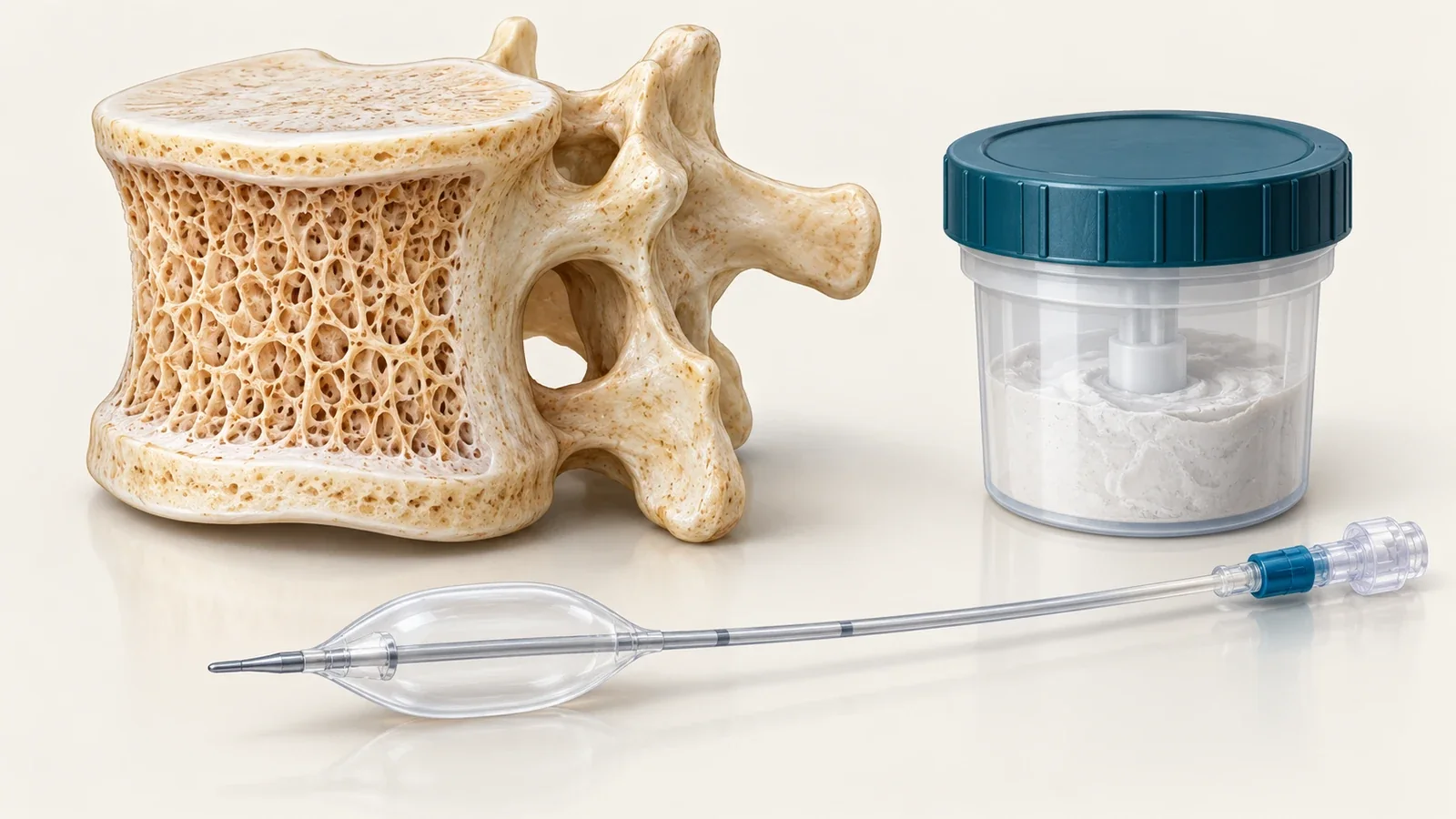
What are vertebroplasty and kyphoplasty?
Vertebroplasty and kyphoplasty are procedures for supporting the vertebral body in selected spinal compression fractures. They are sometimes informally called cementing procedures. Vertebroplasty introduces suitable bone cement into the fractured vertebral body. Balloon kyphoplasty aims to create a cavity with a balloon before cement is introduced. Technical details are planned after assessing the fracture and the person's condition.
These methods are not used for every type of back pain. Not every compression fracture requires intervention either. Assessment investigates whether pain relates to the fracture, its healing status and other possible diseases. Knowing the procedure's name or having vertebral collapse on imaging does not establish suitability.[1]
Why do spinal compression fractures develop?
A vertebral body can lose height when its strength declines or it cannot withstand the applied load. Osteoporosis is one cause, but not all fractures should be attributed to it. Trauma, tumour-related bone involvement and other diseases may also need assessment. Identifying the cause matters for subsequent treatment as well as pain management.
Symptoms and imaging
New back pain may relate to a fracture, while some fractures are found during investigations for another reason. When several vertebrae show changes, identifying the painful level is especially important. Tenderness, pain onset and imaging are assessed together. An old compression deformity should not automatically be assumed to explain current pain.
For whom might intervention be considered?
NICE technology guidance considers these procedures as options for selected people with severe ongoing pain after a recent, unhealed osteoporotic vertebral fracture despite appropriate pain management. Confirmation through examination and imaging that pain arises at the fracture level is among the criteria. These conditions do not mean every fracture patient automatically receives an intervention.[2]
The decision considers daily impact, previous approaches, fracture characteristics and general health. Nerve involvement or substantial structural problems may require another surgical plan. Cement application is not a shared treatment for every fracture type or spinal problem. Suitability should be assessed alongside other options.
What do diagnosis and imaging investigate?
The consultation covers pain onset, trauma, previous fractures and medicines. Examination provides information about the painful region and neurological status. X-rays, MRI or CT may be used according to clinical need. Images help assess fracture structure and its relationship to surrounding tissues.
Fracture age and cause
Some MRI findings can help assess fracture activity and other possible causes. However, one imaging sign does not determine the same decision for everyone. Cancer history, infection signs or unusual findings may prompt additional investigation. The cause of pain should be clarified as far as possible before intervention.
The main differences between the procedures
Vertebroplasty introduces bone cement into the vertebral body under imaging guidance. The balloon in balloon kyphoplasty aims to create a cavity for cement. Although changing vertebral height may be an objective in some cases, restoration of the original shape should not be expected in everyone. Technical aims and clinical pain outcomes are different measures.
Selection relates to fracture shape and procedural circumstances. General superiority claims or decisions based only on equipment names are inappropriate. The team should explain the proposed approach and alternatives. Imaging guidance does not remove the need to assess possible complications.
Uncertainties in scientific evidence
Vertebroplasty studies differ in patient selection, fracture duration, pain severity and comparison methods. A single effect size therefore cannot describe every fracture. Knowing the studied population and circumstances is important for interpreting findings correctly.
The randomised sham-controlled VERTOS IV trial did not demonstrate significant superiority of vertebroplasty over a simulated procedure for pain reduction during follow-up in the studied acute osteoporotic fracture patients. This cautions against presenting it as routine for all compression fractures. The study is one part of the evidence considered before intervention.[3]
Guidance identifying an option for selected patients and a trial finding no additional benefit in a defined group can be explained together. Research should not be ignored to claim rapid pain relief for everyone. Discussion should cover uncertainty, monitoring and possible procedural burdens.
What options exist without these procedures?
Pain control, individualised movement and supports such as a brace where needed may be considered. Their aims and duration depend on the patient. Problems caused by prolonged inactivity are weighed alongside protecting the fracture. Identical rest or exercise programmes should not be recommended to everyone.
Progressive neurological findings, instability or other particular circumstances may require different operations. Options therefore extend beyond choosing between vertebroplasty and kyphoplasty. The possible course without intervention and each method's aim should be explained understandably.
What are the possible risks?
Possible problems include cement leakage into unintended areas, nerve involvement, infection, bleeding and persistent pain. Cement-related circulatory complications may also be discussed. Coexisting diseases and technique affect personal risk. These explanations are not an individual risk percentage or outcome prediction.[1]
New leg weakness, bladder control changes, substantial sensory loss, fever or sudden breathlessness after a procedure require prompt assessment. Severe, sudden symptoms need emergency help. Individual instructions should distinguish symptoms suitable for routine follow-up from those that must not wait.
Why does osteoporosis need separate treatment?
For an osteoporotic vertebral compression fracture, intervention does not remove all causes of osteoporosis or the risk of new fractures. Bone health, suitable medicines and fall prevention are separate issues. Assessment may require contributions from different specialties. Cement application alone is not comprehensive osteoporosis treatment.
Previous fractures, medicines and bone density investigations can be shared. Nutrition, movement and support needs are assessed individually. Everyone should not independently take the same vitamin or supplement. The aim includes planning for future fractures as well as discussing current pain.
How is follow-up organised?
Review reassesses pain, everyday movement and neurological status. Walking, sitting and self-care may be monitored. New pain elsewhere needs investigation; it should not automatically be attributed to the same fracture or procedure. Follow-up tests are arranged as needed.
Work, lifting and exercise advice depends on fracture status and general health. Identical movement targets for a particular day are inappropriate for everyone. Accompaniment, home safety and help with daily tasks may also be discussed. New findings can lead to changes in the follow-up plan.
Frequently asked assessment questions
Are all compressed vertebrae treated if several are affected?
Several vertebrae may have lost height. Decisions do not depend only on their number; the pain source and fracture characteristics are investigated. Examination and suitable imaging help distinguish old and new findings. Not every visible change is necessarily treated in one session.
Does new pain mean the same fracture?
Pain in another region during follow-up may reflect a new fracture, muscle symptoms, joint problems or other causes. Tell the team when it began and how it affects daily life. Previous cement treatment does not mean every later pain can be addressed with the same procedure.
Share previous osteoporosis treatments and falls. Clarify ongoing medicines with the relevant doctor. Existing treatment should not be stopped solely because an intervention has been performed. Current fracture follow-up and long-term bone health planning should continue together.
Vertebroplasty and kyphoplasty assessment in İzmir
Assessment for spinal compression fracture treatment in İzmir reviews images, pain progression, previous fractures and treatments together. Op. Dr. Ozan Ganiüsmen's practice address is on the contact page. This article provides general information; the need for intervention and a possible approach require individual assessment.
Scientific and Institutional Sources
- AANS — Vertebral Compression Fractures
Professional society patient information; causes, options and possible risks
- NICE TA279 — Percutaneous vertebroplasty and balloon kyphoplasty: recommendations
Technology assessment; recent unhealed osteoporotic fracture, severe pain and clinical–imaging agreement
- VERTOS IV — Vertebroplasty versus sham procedure for painful acute osteoporotic vertebral compression fractures
Sham-controlled randomised trial; no added pain benefit in the studied group, without claims for all fractures