What does peripheral nerve repair aim to achieve?
Peripheral nerve repair covers operations considered to restore signal transmission after injury to nerves outside the brain and spinal cord. Cuts, crushing, stretching or other trauma can affect fibres to different degrees. Some injuries preserve continuity; others completely divide the nerve. Monitoring and treatment differ. Where necessary, surgery aims to join ends under suitable conditions or bridge a tissue gap.[1]
Repairing the outer structure and recovering sensation or movement are separate processes. Fibres may take time to reconnect with target tissues, and not all reach appropriate targets. Normal feeling or strength immediately after surgery should not be expected. Location, extent, duration and associated tissue injury affect outcomes. This article concerns traumatic peripheral injuries, rather than a shared repair approach for spinal cord injury or every widespread neuropathy.
How is nerve injury assessed?
Injury history and functional examination
The doctor asks about timing, mechanism and immediate numbness or movement loss. Sensory territories, inactive muscles and pain features are examined. Vessel, tendon, bone or joint injuries may coexist. Open injuries particularly require assessment of circulation, bleeding and infection together. Recent injury needs timely medical assessment rather than waiting at home.[2]
Conduction studies and electromyography answer particular questions, but immediate testing may not reveal the full injury. The timing of the test, which nerve has been examined and how its findings relate to the clinical examination should all be explained to the person. Ultrasound or MRI may show continuity and surrounding tissues. Suspected fracture or joint injury may require other images. Repeated comparison over time of the same muscles and sensory regions helps monitor recovery.
How are surgery and timing decided?
An open injury suggesting division and a closed stretch injury follow different timetables. Some closed injuries can be monitored for recovery, while others may need exploration or repair. Injury length, wound cleanliness, tissue loss and vascular problems may change planning. Numbness alone or reduced pain does not confirm preserved continuity.
Timing of nerve repair considers target muscles and injury level. Options may remain after delayed presentation, but decisions between direct repair, transfer and other functional procedures may differ. Complex injuries may require teams experienced in peripheral surgery and rehabilitation. A procedure offered at one institution is not a standard option for every injury.[3]
Direct repair versus grafting
End-to-end repair
Where suitable, the ends are brought together under magnification. The principle is connection without unnecessary tension. This is not simply the mechanical result of joining a broken cable: internal fibres must subsequently grow. Technique and details depend on the injured region.
Bridging with a nerve graft
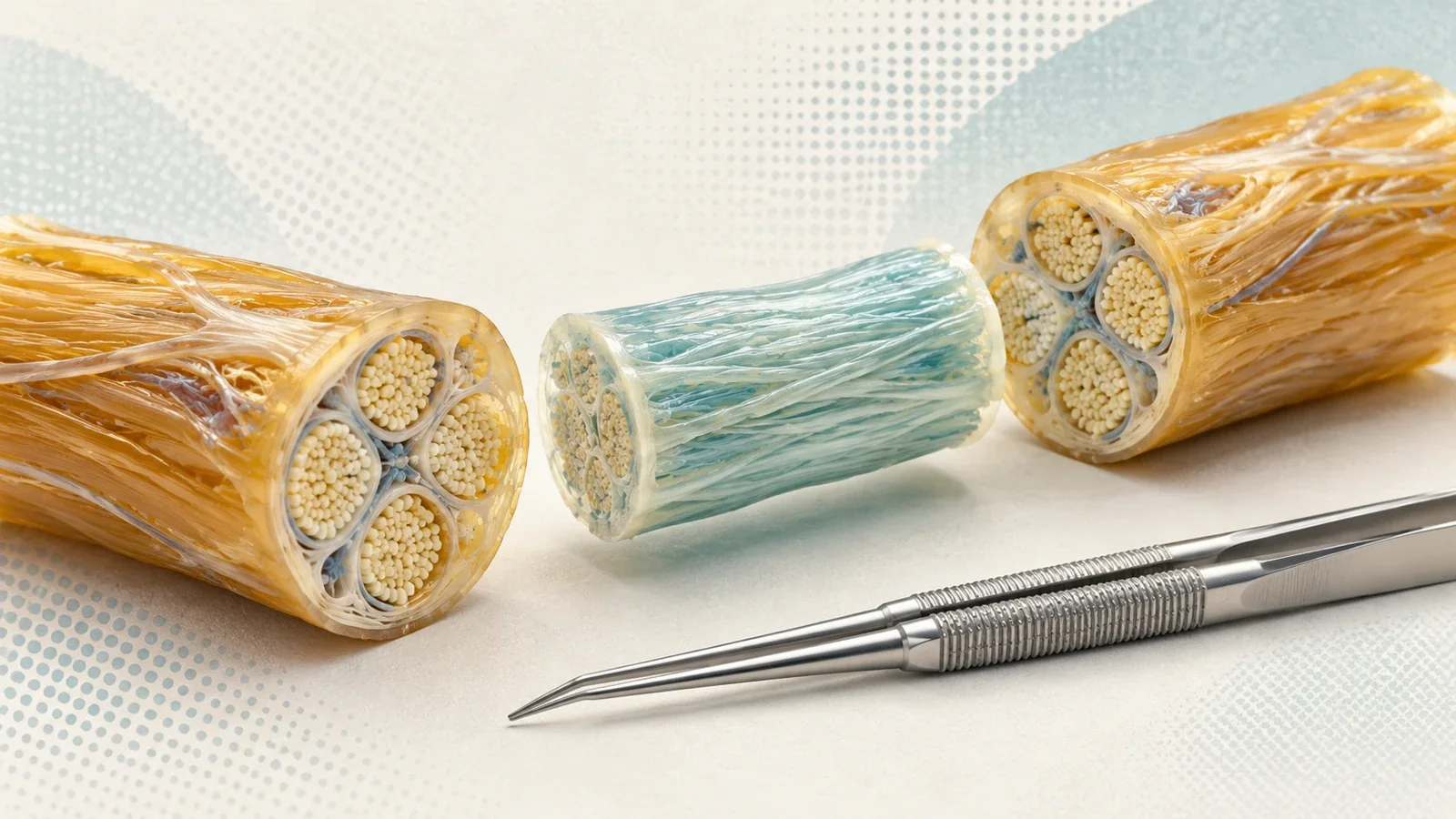
If ends cannot meet without tension, a graft may bridge the gap. A nerve segment from another body region may be used, with possible sensory change or scarring at the donor site. Processed donor material and conduits require separate product-, injury- and evidence-specific assessment. Graft types are not universally interchangeable or equally effective. Use in one country does not establish Turkish authorisation.[4]
Other options and non-surgical care
Some injuries with preserved continuity may be monitored, protected and rehabilitated. Selected cases may involve releasing external pressure or scar, transferring an intact branch, or functional procedures such as tendon transfer. These are not different names for one operation. The intended function and healthy structure to be used should be clear.[2]
Protect numb areas from heat, sharp objects and pressure. Reduced temperature awareness may allow unnoticed injury. Splints, maintaining joint movement, sensory training and pain care where needed form part of treatment. Exercise balances function with repair protection. Rehabilitation should match surgery rather than be regarded as an unrelated extra. Intensive massage or forceful stretching should not be started independently.
Preparation and discussing expectations
Bring emergency records, operative notes, images and nerve tests. Report medicines, blood thinners, allergies, smoking and general health. The team decides medicine changes. Open wounds, infection or tissue loss may require several treatment stages. In some injuries, not finalising every detail initially reflects the injury's nature.
Record baseline loss and understand priorities. Discuss occupation, dominant hand, daily care and home support. The treatment goal may be regaining protective sensation, making one particular movement possible or managing pain. These are separate aims and should be identified clearly during discussion. Their likelihoods differ. Return to work depends on safe feeling and muscle control as well as incision healing. Explain possible lengthy rehabilitation from the outset.
Risks and recovery limitations
After peripheral nerve grafting, infection, bleeding, wound problems and scarring may occur. Painful nerve-end formation, persistent numbness, unwanted sensations or inadequate movement recovery are possible. Donor areas may lose sensation or become tender. Associated vessel, tendon or bone injury also affects function. Completed nerve repair therefore does not mean the entire limb will return to its previous state.
Approximate fibre growth rates in references should not become personal recovery timetables. Age, level, tissue injury and target distance differ. Returning sensation and fine discrimination are not the same. Even if muscle reinnervation occurs, strengthening and skills training may be needed. Some losses may remain permanent; additional procedures or aids may be considered.[1]
How are follow-up and rehabilitation organised?
Early care protects the repair, later developing movement and function. Splint position and use follow a joint surgeon–therapist plan. Restrictions differ between repairs. Reviews monitor wounds, stiffness, sensation and muscle activity. Progress may be slow; regular records help avoid focusing solely on daily fluctuations.[3]
Increasing redness, discharge, fever, sudden swelling, new circulation problems or unexpected severe pain should be reported. Areas without protective sensation need workplace and home protection. Ergonomic changes, equipment or different duties may help return to tasks. Review intervals and repeat tests depend on progress. Outcomes should not be reduced to photographs or a single strength measurement.
Common questions and seeking care in İzmir
Does feeling return immediately when a nerve is stitched?
No. Surgery aims to create a structure through which fibres can grow; restored transmission is a separate biological process. Early persistent numbness alone does not establish failed repair. Expected progress should be explained at reviews.
Is a nerve graft stem cell treatment?
Grafts and cellular products are different methods. Grafting aims to create a tissue bridge. Material type, source and limitations should be specified during consent.
People seeking nerve injury treatment in İzmir should describe the date and functional changes since injury. Op. Dr. Ozan Ganiüsmen's neurosurgical information explains general repair principles. Depending on extent, peripheral nerve, hand surgery, orthopaedic and rehabilitation teams may need to assess together; suitable centres and teams depend on individual findings.
Scientific and Institutional Sources
- Cambridge University Hospitals — Peripheral nerve injuries of the upper limb: surgical repair
Distinguishing outer structural healing from fibre growth, protection and rehabilitation
- AAOS OrthoInfo — Nerve Injuries in the Hand and Fingers
Injury types, associated damage and distinctions between direct repair, grafts and transfers
- Royal National Orthopaedic Hospital — Peripheral Nerve Injury Unit
Specialist team approach to complex acute and chronic nerve injuries
- NICE HTG454 — Processed nerve allografts to repair peripheral nerve discontinuities: indications and current treatments
Distinguishing graft types and donor-site issues; no inference of Turkish authorisation or equivalent effects