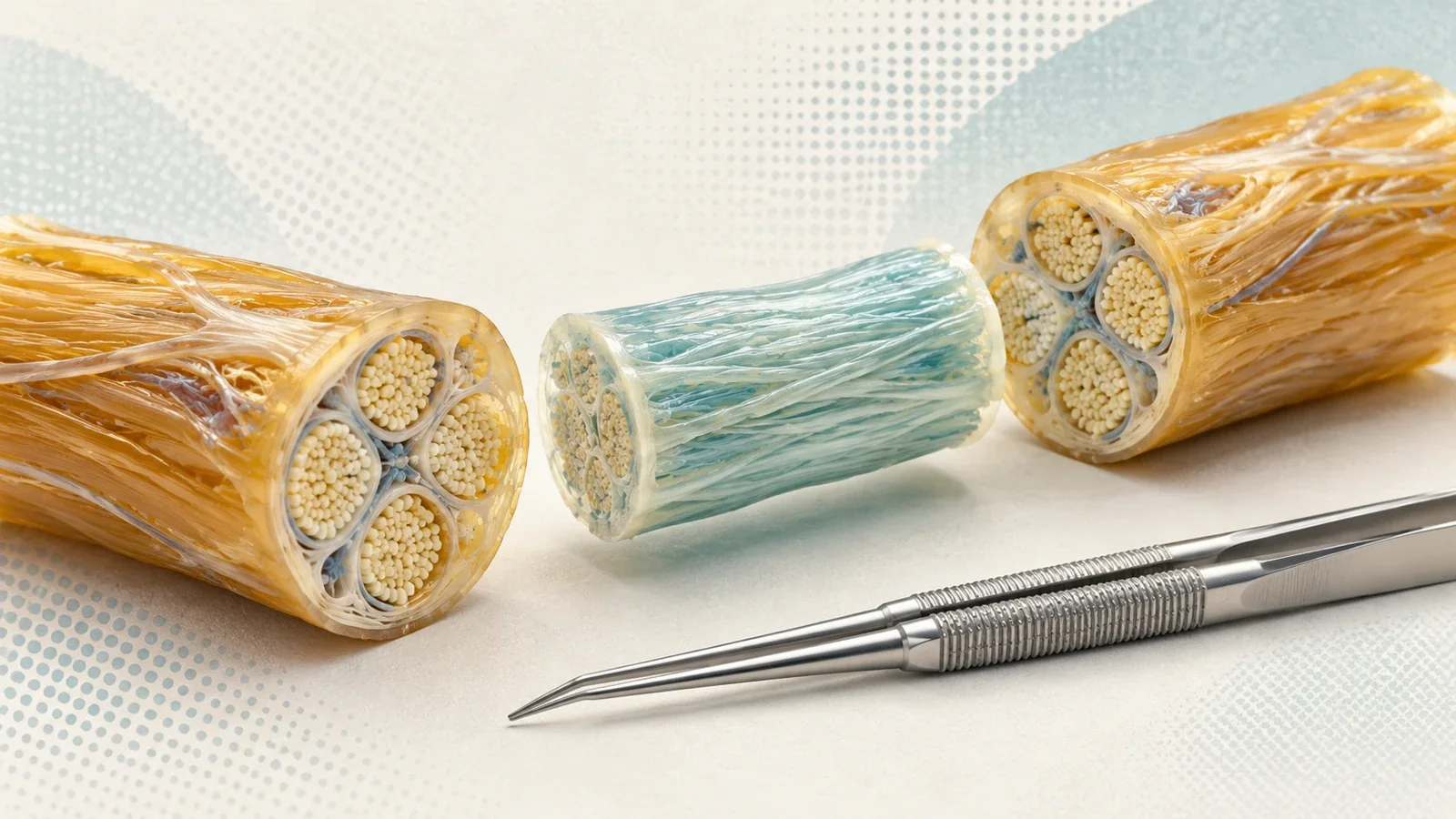
What is a peripheral nerve injury?
Depth of damage affects recovery
A peripheral nerve injury damages nerves outside brain and cord through cutting, crushing, stretching or trauma. Nerves convey motor commands, sensation and some automatic functions. Damage may cause numbness, weakness or pain in external structures and internal fibres to varying degrees.[1][2]
A mild temporary conduction problem differs from complete nerve division. Some injuries recover without repair while others need surgery. An externally small cut can conceal significant nerve, tendon or vascular damage, and closed trauma may affect nerves without a visible wound. Location, mechanism, elapsed time and associated tissue injury change planning. Numbness severity alone cannot determine depth or whether continuity has been preserved.
What matters initially?
Assess vessels and tendons too
Sensory loss, inability to move, burning or electric pain after cuts may suggest injury. Crush symptoms may change with swelling. Coldness, pallor or uncontrolled bleeding imply vascular urgency. Open wounds, weakness or rapidly worsening pain need prompt care rather than waiting.[2]
Initial examination records pre-injury function, sensory distribution, muscle movements, tendons and circulation. Explain mechanism and wound contamination. Foreign bodies or fractures may need investigation too. Numb skin can be injured unnoticed by heat or sharp objects. Pain does not establish an intact nerve. Comparing the same movements and sensory areas during later examinations helps record recovery or deterioration. These observations support decisions alongside tests and previous operative information.
Why does testing timing matter?
Examination and electrophysiology together
Open injury may need surgery without waiting for EMG. EMG and conduction studies can assess complex or closed injuries, but immediate tests may miss changes. Specialists choose questions and repeat timing.[2][3]
Ultrasound or MRI may assess continuity, compression, scarring or surrounding tissue in selected patients. Fracture or foreign bodies may need other imaging. No single test establishes recovery prospects. Injury level, distance to target muscles, general health and associated damage matter together. Previous operation notes are particularly useful, including repair timing, affected nerve and graft use. Record stiffness and muscle loss too: these can limit movement even if the nerve recovers. Assessment should therefore extend beyond the nerve itself.
Which injuries may be monitored?
Preservation requires active care
Selected closed injuries with continuity may have monitored rehabilitation. Look for expected sensory and muscular change. Splints may prevent stiffness or poor posture. Exercises reflect other repairs; tendon injuries differ. Protect numb skin from burns, pressure and cuts.[1][2]
Neuropathic pain care and sensory retraining may be added to rehabilitation where needed. Less pain alone does not establish that signals are reaching muscles again. Forceful independent stretching or massage is not suitable for every injury. Monitoring needs clear goals: which function should change and which assessment follows if progress is absent. Do not delay specialist peripheral nerve referral when needed. Complex injuries may require several surgical and rehabilitation disciplines working together.[3]
What repair options exist?
Direct repair, graft and transfer
Suitable divided nerves may be joined without tension. Gaps may need grafts or selected bridges. Nerve transfer redirects a healthy branch and differs from grafting. Level, duration and muscles guide selection. Processed donor and own-tissue grafts require separate assessment.[2][4]
Joining the outer structure does not complete biological recovery at the same moment. Fibres need time to reach targets and function may remain incomplete. Infection, scars, painful nerve ends, donor-site sensory loss and additional procedures are possible. Some delayed cases may discuss functional procedures such as tendon transfer. Cellular or biological products should not be presented as equivalent to standard repair or as proven regeneration. Explain the specific method and its limits before choosing it.
How long does follow-up last?
Motor and sensory recovery differ
Duration depends on site, injury and repair. Universal growth-rate calendars cannot promise recovery. Protection, movement, strengthening and sensory training are individual. Report weakness, swelling, discharge or increasing pain. Record tasks and rehabilitation goals too.[1]
Bring the trauma date, operative notes, images and EMG to nerve injury consultation in İzmir. Op. Dr. Ozan Ganiüsmen can discuss location, timing and the need for specialised peripheral nerve or hand surgery teams. The decision focuses on sensation and movement that may be preserved as well as pain reduction. Communication with rehabilitation and everyday protective habits remain important parts of long-term care. The history helps compare current function with the original injury and subsequent interventions. Bring injury records, previous operations and nerve test results to the consultation if available. Describe how sensation, movement and everyday tasks have changed over time. These details help the team interpret current findings, discuss treatment aims and agree which aspects of function should be monitored during rehabilitation and follow-up.
Scientific and Institutional Sources
- Cambridge University Hospitals — Peripheral nerve injuries of the upper limb: surgical repair
Distinguishing outer structural healing from fibre growth, protection and rehabilitation
- AAOS OrthoInfo — Nerve Injuries in the Hand and Fingers
Injury types, associated damage and distinctions between direct repair, grafts and transfers
- Royal National Orthopaedic Hospital — Peripheral Nerve Injury Unit
Specialist team approach to complex acute and chronic nerve injuries
- NICE HTG454 — Processed nerve allografts to repair peripheral nerve discontinuities: indications and current treatments
Distinguishing graft types and donor-site issues; no inference of Turkish authorisation or equivalent effects