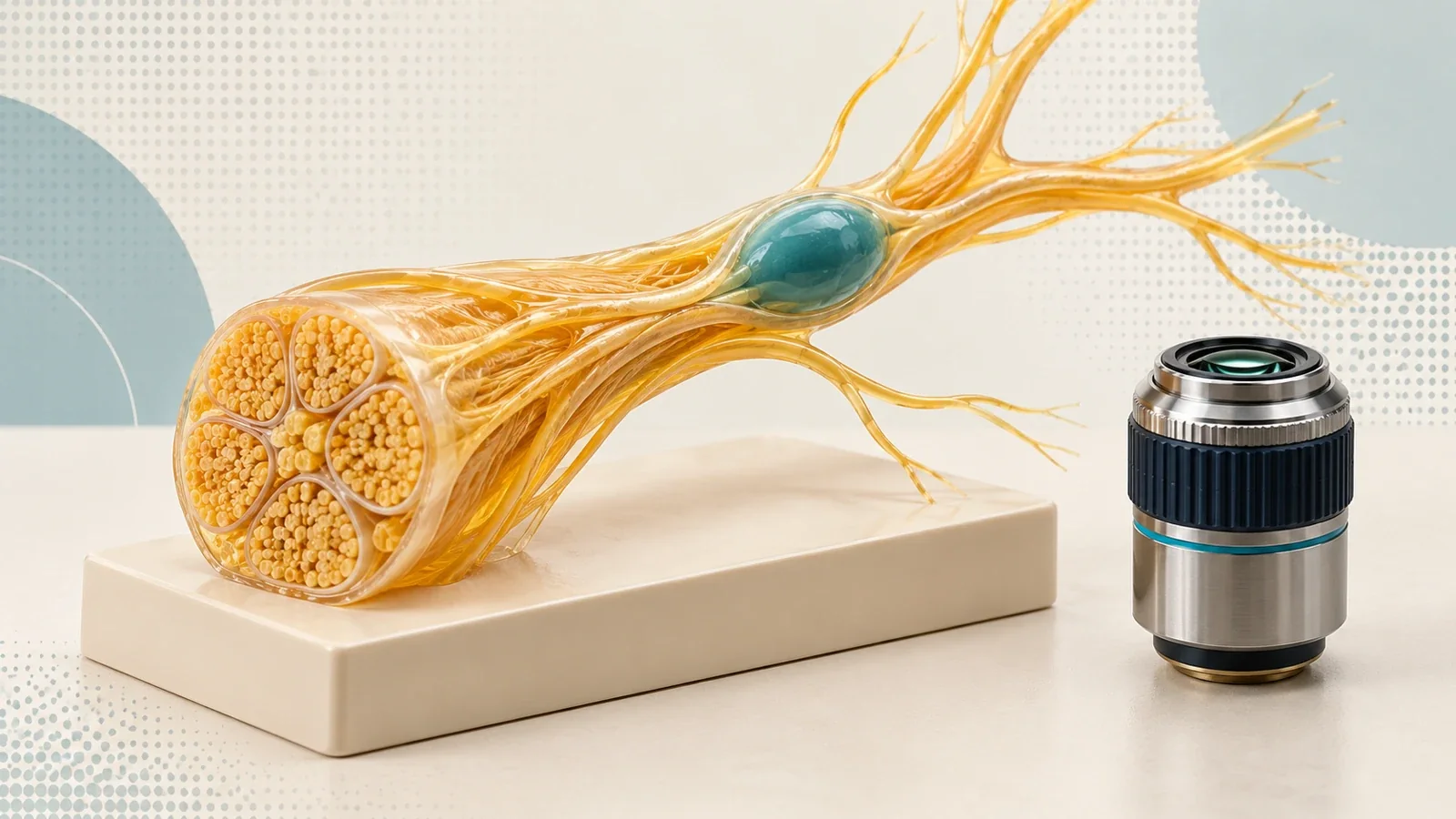
What does nerve sheath tumour surgery involve?
Nerve sheath tumour surgery aims to remove certain masses arising from peripheral nerves or their surrounding tissues. Schwannomas and neurofibromas may belong to this group. Not every nerve sheath tumour is malignant, but all masses should not be assumed to behave identically. The relationship to the nerve, location, growth and symptoms influence planning. This article mainly concerns tumours associated with peripheral nerves in the arms, legs and trunk.[1]
Intracranial locations such as vestibular schwannoma of the hearing and balance nerve require different assessment pathways. Risks in one region cannot be transferred directly to another. A soft-tissue mass pressing on a nerve from outside also differs from a tumour arising in its sheath. The aim is to address the mass while preserving sensation and movement as far as possible. Complete removal sometimes needs balancing against preservation of nerve function.
Diagnosis and assessment before surgery
Examination and imaging
The consultation asks when the mass was noticed, whether it is growing, whether touching it causes electric sensations and whether movement or feeling has changed. Strength and sensation in specific areas are examined. Family history and multiple similar masses may matter. These do not independently establish an inherited condition; separate assessment and genetic counselling may be considered where necessary.
MRI helps show relationships with nerves and surrounding tissues. Ultrasound may inform selected superficial masses. Nerve conduction testing is not compulsory for every mass but may assess existing functional loss. Imaging suggesting a benign lesion is not equivalent to a definitive tissue diagnosis. Clinical and imaging findings are considered together, including whether pathological examination is needed.[2]
Does every mass require a biopsy?
Planning biopsy of a nerve-related mass requires attention to where and how tissue is taken. A separate preliminary biopsy may not be necessary for every nerve sheath tumour. Imaging and clinical assessment may instead lead to monitoring or removal. Suspected malignant lesions require a specialist team to determine diagnosis and treatment. Treating such a mass as an ordinary lump under the skin may be inappropriate.[2]
Consider whether a biopsy sample would change treatment. Previous biopsies and operations may affect later planning, so provide all reports and tissue results. Rapid growth, new functional loss or changing pain require reassessment. These do not alone diagnose cancer but may warrant prompt medical advice. General online explanations cannot determine whether a mass is benign or malignant.
How are monitoring and surgery compared?
Some small, symptom-free lesions considered benign after assessment can be monitored. Monitoring is an active plan for examination, imaging and new symptoms, rather than ignoring the issue. Growth, pain, sensory change or weakness may prompt renewed surgical discussion. Position along the nerve and possible functional loss from removal matter when weighing benefit.[1]
A schwannoma operation is not decided by diameter alone. A small lesion in a sensitive location may cause symptoms while a larger one elsewhere may remain silent. Suspected malignancy may require sarcoma and oncology planning alongside peripheral nerve expertise. This differs from removal of a benign schwannoma. General health, expectations and postoperative support also need discussion.
General surgical principles
The general aim is removal while preserving surrounding functional nerve tissue. Magnification and, where appropriate, nerve monitoring may help. Relationships to nerve bundles may become clearer during surgery. Some lesions separate from bundles more readily than others. Complete removal should therefore not be individually guaranteed beforehand.[2]
Preservation may require partial removal, limiting the procedure or another treatment plan. Consent should explain circumstances in which the approach could change. Pathology of removed tissue guides later monitoring. An unexpected diagnosis may prompt additional investigation and specialist assessment. Technique varies by location; a video of one region may not apply elsewhere.
Other treatments and team-based care
Monitoring and surgery are commonly considered for benign peripheral nerve tumours. Radiotherapy and medicines are not routine for every sheath tumour. Malignant peripheral nerve sheath tumours require separate planning based on oncological features and spread. Relevant oncology teams assess additional radiation or systemic treatment. Radiosurgery information for certain intracranial nerve tumours should not be generalised to all peripheral tumours.[3]
Pain care and rehabilitation may be necessary regardless of the main treatment. Functional loss may call for aids, workplace adjustments and physiotherapy. Multiple tumours or inherited syndromes may broaden monitoring. Similar disease names do not require identical screening for everyone. Specialists determine which organs or regions need assessment.[4]
What matters in preparation?
Bring actual previous images alongside their reports. Earlier biopsy reports and operative notes help explain how the mass was previously managed. Report medicines, blood thinners, allergies and other conditions. Do not stop medicines independently. Infection, new skin wounds or general health changes should prompt contact with the team.
Recording baseline strength and sensation allows later comparison. Discuss difficult daily tasks and hoped-for changes. Pain or numbness may remain despite removal. Hospital stay, dressings, movement restrictions and home support depend on location. Work planning should consider nerve functions rather than incision size alone.
Possible risks and lasting effects
After peripheral nerve tumour surgery, bleeding, infection, wound problems, scar sensitivity and pain may occur. Effects on the nerve may cause numbness, altered sensations or weakness. Changes may be temporary or permanent. Risk differs with location and function. Data for one tumour type cannot predict personal risk for every nerve mass.
Incomplete removal or later regrowth should also be discussed. New imaging or additional treatment may be needed. Malignant pathology changes follow-up aims and scope. A clear plan helps manage uncertainty. Patients should know expected findings and changes requiring contact. Outcomes concern nerve function as well as disappearance of the mass on imaging.[1]
Reviews and rehabilitation
Early reviews assess healing, pain, sensation and strength. Pathology should be discussed clearly, including the tumour name, biological behaviour and next steps. Imaging frequency depends on type, extent of removal and findings. Benign lesion follow-up and malignant oncological surveillance differ. Dates should not be changed based on another patient's experience.
Weakness or restricted movement may require individually targeted rehabilitation. Numb areas may need protection from injury. New or worsening weakness, rapidly growing swelling, wound discharge, fever or unexpected severe pain should be reported. Avoid uncontrolled massage or strenuous exercise over the site. Functional recovery may take time and is assessed through everyday skills too.
Common questions and assessment in İzmir
Does every schwannoma require surgery?
No. Some benign, symptom-free tumours can be monitored. Growth, symptoms, function and diagnostic features together determine surgical need. Monitoring requires a clear review plan.
Can a benign tumour harm a nerve?
Benign does not mean it has no local effects. Effects on the nerve or adjacent tissues may cause symptoms. Preserving function is considered separately from the possibility of cancer.
People seeking nerve sheath tumour treatment assessment in İzmir can bring previous images and pathology documents. Op. Dr. Ozan Ganiüsmen's neurosurgical information aims to explain decisions between monitoring and surgery. Depending on the mass, peripheral nerve, radiology, pathology, oncology and rehabilitation teams may need to plan together.
Scientific and Institutional Sources
- Royal National Orthopaedic Hospital — A patient's guide to Nerve Sheath Tumours
Peripheral schwannomas, monitoring versus surgery and risks; institutional numerical outcomes not reproduced
- Mayo Clinic — Nerve sheath tumors: diagnosis and treatment
Selective biopsy, nerve-preserving surgery and multidisciplinary decisions
- NHS — Treatment for soft tissue sarcoma
Disease-specific oncology planning for malignant tumours; not generalised to benign lesions
- Mayo Clinic — Nerve sheath tumors: symptoms and causes
Benign versus malignant and peripheral versus intracranial distinctions; assessment of associated syndromes