What is a peripheral nerve tumour?
Different masses arising from nerve sheaths
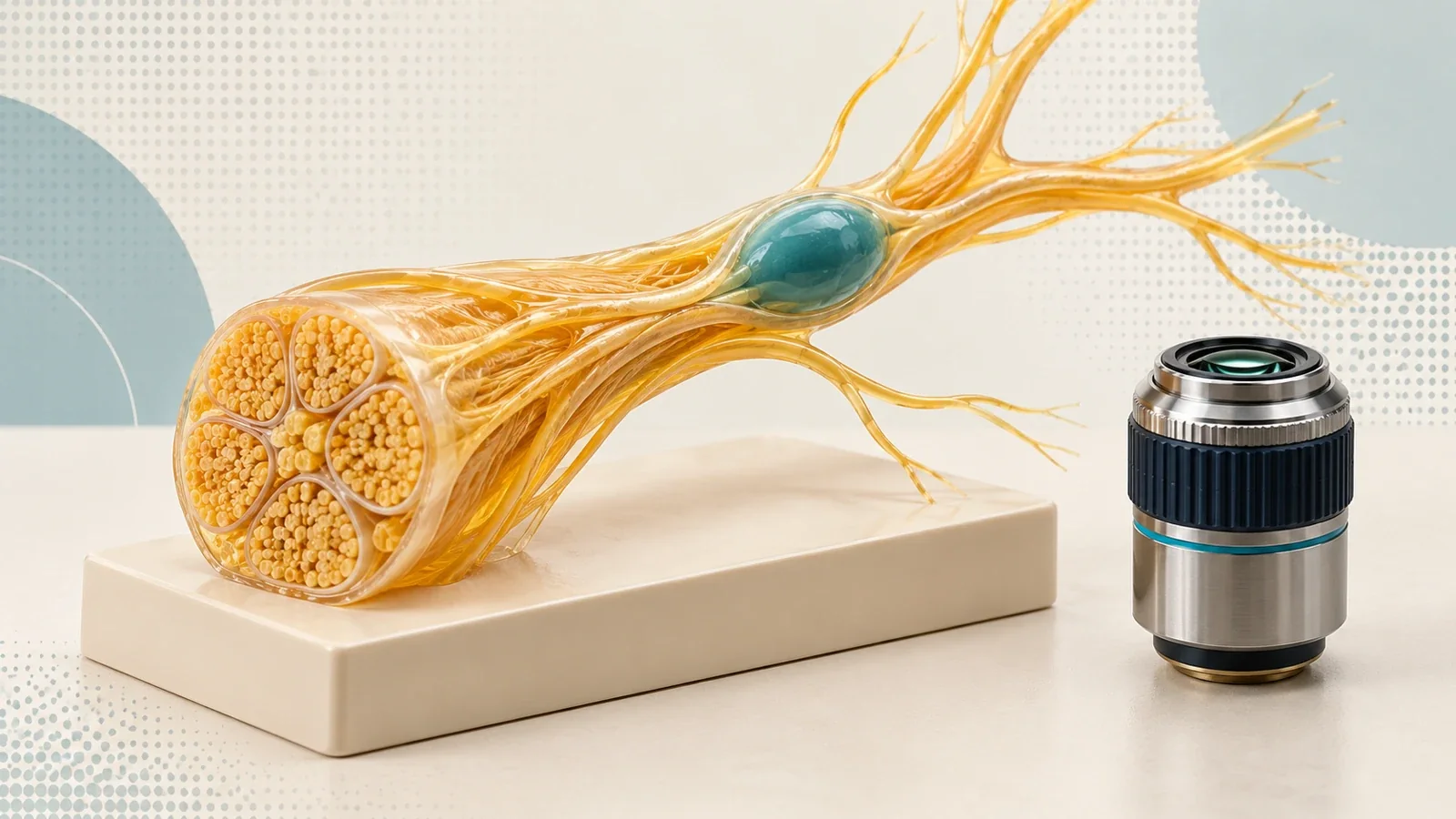
Peripheral nerve tumours arise within nerves outside the brain and spinal cord or their surrounding supporting tissues. Benign types include schwannomas and neurofibromas. Rarer malignant peripheral nerve sheath tumours need a separate oncological assessment. Not every swelling felt along a nerve beneath the skin is a nerve tumour: cysts, fatty masses and other soft tissue lesions can have a similar appearance.[1][4]
A benign tumour may still cause pain or loss of nerve function. Its relationship to nerve fibres matters when planning surgery: some tumours push fibres aside, whereas others are more closely interwoven with the nerve. A solitary tumour may occur without an inherited disorder. Multiple lesions, family history or other findings may justify specialist assessment for associated inherited conditions. This does not mean that every solitary mass requires the same tests.
Which symptoms need assessment?
Monitor growth and function together
A slowly growing swelling, an electric sensation when pressed, pain or numbness along a particular nerve may prompt consultation. A deep mass may not be visible externally. Muscle weakness or changes in hand or foot function can suggest nerve involvement. Some tumours are discovered during imaging for another reason. Pain alone does not establish that a tumour is malignant.[1][4]
Rapid growth, new or substantially increasing pain, hardening and progressive neurological loss require closer investigation. A change in a previously diagnosed neurofibroma is particularly important. These symptoms still cannot establish a cancer diagnosis remotely. Record how long the mass has been present, its previous size and its effects on daily life. Squeezing it, trying to drain it with a needle or having it removed without appropriate planning may injure a nerve and complicate subsequent treatment.
Which investigations help establish the diagnosis?
Planning the biopsy route is part of treatment
Examination assesses location, mobility, sensations produced by touch, and the relevant nerve's sensory and muscle function. MRI provides information about the nerve relationship and surrounding tissues. Ultrasound may help with superficial masses. EMG can assess functional loss in selected patients; it cannot independently classify a mass as benign or malignant. Earlier images are useful when assessing growth.[1][2]
A biopsy is not automatically the first step for every nerve mass. A needle or incision can damage fibres; if malignancy is suspected, the sampling route may also affect the future surgical field. Biopsy of a suspicious mass should therefore preferably be planned with the team responsible for treatment. Observation or direct surgery may be considered differently for suitable, typical benign lesions. Pathology is interpreted alongside imaging and clinical findings, with specialist soft tissue pathology review where needed.
Who may be suitable for observation?
Function matters alongside stable size
Some asymptomatic, slowly developing benign nerve sheath tumours with reassuring features can be monitored. Reviews assess size, pain and neurological changes. Timing depends on location and diagnostic confidence. Patients need to understand which new findings to report. An appropriate observation decision for one mass does not automatically apply to another, even if their names or appearances seem similar.[1][2]
Pain management and rehabilitation may support function but do not remove the mass. Surgery is reconsidered for growth, pain or weakness. Suspected malignancy should not be managed by prolonged reliance on painkillers alone. Injecting every mass around a nerve is not a standard approach either. Work, dominant hand, walking and skills needing protection are discussed. These practical details help assess the balance between intervention and observation in the individual patient.
How do surgical and oncological treatments differ?
Balancing nerve preservation and cancer margins
For a benign tumour, suitable surgery aims to remove the mass while preserving functioning fibres. Microsurgical techniques and, where appropriate, nerve monitoring may be used. Risks nevertheless include numbness, weakness, neuropathic pain, bleeding and infection. Some tumours are so closely related to the nerve that complete removal may threaten important function. Options and their limitations should be discussed openly before an operation.[1][2]
A suspected malignant peripheral nerve sheath tumour requires a different plan. A specialist soft tissue sarcoma team considers surgical margins and any radiotherapy or systemic treatment together. Difficult decisions may arise between preserving nerve function and removing cancer with appropriate margins. General information for a benign schwannoma cannot simply be transferred to this group.[3] Surgery cannot promise relief of all pain or entirely normal nerve function. Reconstruction and rehabilitation needs may be discussed from the outset.
What follow-up is needed?
New masses and changes in function
Follow-up depends on pathology, extent of removal and nerve function. Reviews assess the wound, sensation, strength and pain, with imaging when needed. Multiple lesions may require a broader specialist plan. Report a rapidly growing new mass, a marked change in pain or new weakness without waiting for the routine appointment. Monitoring addresses the person's function as well as the appearance of the treated area.[2][4]
Bring previous MRI images, size comparisons and any biopsy reports to a nerve mass consultation in İzmir. Op. Dr. Ozan Ganiüsmen can assess the nerve relationship and the need for a specialist peripheral nerve or sarcoma centre. If biopsy has not yet been performed, clarify the appropriate team and procedure beforehand. Decisions should reflect functional effects and diagnostic uncertainty alongside the name of the mass.
Scientific and Institutional Sources
- Royal National Orthopaedic Hospital — A patient's guide to Nerve Sheath Tumours
Peripheral schwannomas, monitoring versus surgery and risks; institutional numerical outcomes not reproduced
- Mayo Clinic — Nerve sheath tumors: diagnosis and treatment
Selective biopsy, nerve-preserving surgery and multidisciplinary decisions
- NHS — Treatment for soft tissue sarcoma
Disease-specific oncology planning for malignant tumours; not generalised to benign lesions
- Mayo Clinic — Nerve sheath tumors: symptoms and causes
Benign versus malignant and peripheral versus intracranial distinctions; assessment of associated syndromes