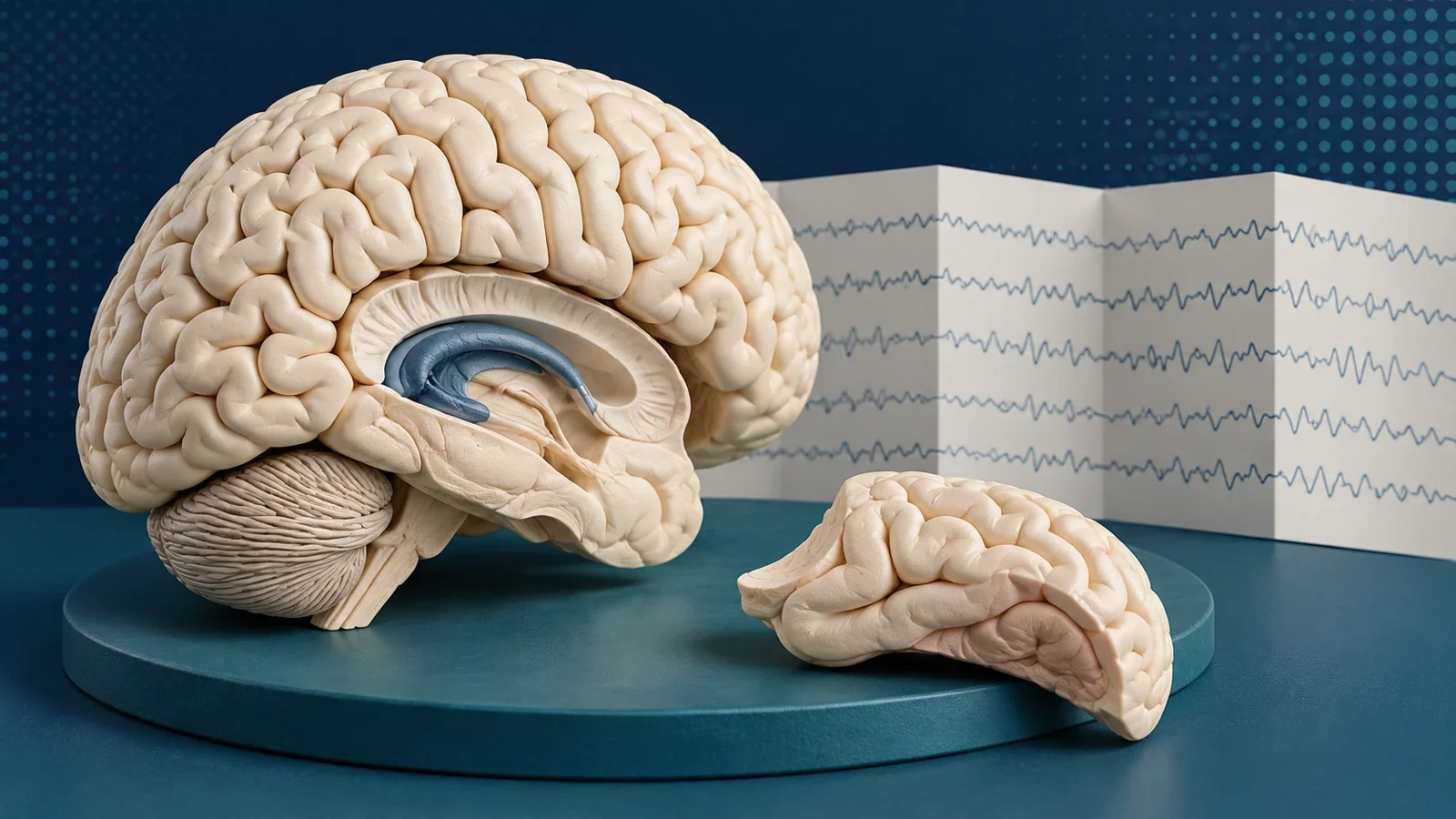
What does epilepsy surgery include?
Epilepsy surgery includes different procedures targeting the brain region where seizures begin or the networks involved. Some remove an onset region, others disconnect pathways, and others use electrical stimulation to reduce seizure burden. It is therefore not one operation. The aim depends on epilepsy type and assessment findings.[1]
Not everyone with epilepsy is a candidate. Many continue medication management. Persistent seizures despite appropriately selected medicines warrant assessment at a specialist centre. Referral does not mean an operation has been decided; it enables detailed diagnosis and review of options.
Are seizure freedom and reduction the same goal?
No. Some operations aim for freedom, others for fewer disabling or drop-causing seizures. Explain realistic goals beforehand. Frequency, types, function and medication effects matter together. An operation name alone cannot predict results.[2]
Drug resistance and referral
Assessment of drug-resistant epilepsy reviews appropriate selection, adequate use and whether events are genuinely epileptic. Continuing seizures despite suitable trials can justify comprehensive centre review. Independently stopping medicines to test resistance is unsafe.[3]
ILAE consensus emphasises referral for suitable drug-resistant patients. This also verifies diagnosis and revisits every option, rather than merely finding surgical candidates. Long duration alone does not justify abandoning assessment.
What if MRI shows no lesion?
A normal standard MRI does not automatically exclude every surgical option. Epilepsy-protocol review and other tests may help. Conversely, a lesion alone does not prove onset there. Agreement between findings is sought.
Investigations before surgery
History, relatives' observations and records form the basis. Video EEG links behaviour during events with electrical activity. MRI shows structure. Functional imaging and other tests may be selected according to the clinical question; not everyone needs everything.[4]
Neuropsychological assessment examines memory, attention, language and other cognitive functions. It is not merely a way of producing a score: it helps discuss which functions surgery might affect and provides information for understanding later change. Psychiatric assessment may address emotional difficulties and possible postoperative support needs. For people with learning difficulties, the assessment should be adapted to their communication characteristics. Findings are considered with other tests rather than used independently to describe the whole surgical decision.
Are intracranial electrodes compulsory?
No. When external recordings do not sufficiently explain onset, the team may discuss intracranial EEG. This has separate procedural, admission and risk requirements. Explain the question and how information could change decisions; it is not used for every candidate.
Which approaches exist?
Resective surgery removes tissue identified as contributing to seizures, including selected temporal operations or lesion removal. Others may need disconnection. Selection considers networks and preserved functions. Operations are not interchangeable standard alternatives.[1]
Neuromodulation stimulates networks rather than removing onset tissue. Vagus nerve stimulation and other selected systems have separate criteria, sometimes relevant where removal is unsuitable. It should not promise elimination of all seizures.[2]
Image-guided ablation depends on location, evidence, centre expertise and national conditions. Every online technique is not a universally available service or suitable for every epilepsy. The individual rationale matters alongside the name.
Decisions and alternatives
Conferences combine neurology, neurosurgery, neurophysiology, neuroradiology and neuropsychology. Benefit is weighed against memory, language, movement and vision risks. Insufficient information may lead to further testing or monitoring without surgery.[3]
Alternatives may include adjusting medicines, specialist-supervised dietary treatments for suitable patients and other support. The risks of leaving epilepsy untreated or seizures uncontrolled also belong in discussion. Daily life, education and work goals, seizure-related injuries and family support all matter when deciding. Information should be given in language the person understands, with enough time for questions. These considerations help relate the clinical plan to the patient's own circumstances rather than treating the operation as the only issue.
Possible risks and uncertainties
Infection, bleeding, anaesthetic problems and neurological injury may occur. Location may affect fields, memory, language or movement. Mood changes or worsened psychiatric symptoms need consideration. Risks require personal test findings rather than a general name alone.[5]
Temporal lobe operations particularly require detailed information about memory and word-finding skills. The dominant hemisphere and the person's level of function before surgery matter. Assessment helps reduce risk but cannot remove every possibility. Seizures may continue after an operation or return over time. These possibilities should be understood alongside the potential benefit rather than being inferred from the operation's name alone.
Are medicines stopped immediately?
No. Antiseizure medicines generally continue according to the team's plan. Later changes consider course and risks. Early seizures alone do not establish a permanently poor result. Record all changes and inform neurology.[4]
Preparing for admission
Report an updated medicine list, allergies, previous operations and general health problems. The centre provides written fasting, medication and admission guidance. Do not stop blood thinners or other medicines without consulting a doctor. Plan practical matters such as support at home, transport and time away from work in advance.[6]
The person's seizure safety plan can be shared with caregivers. During some postoperative periods, fatigue and difficulty concentrating may affect everyday tasks. Return to work or education should therefore not be set by a single calendar that applies to everyone. The review team's advice and the individual's recovery course guide practical arrangements. Planning support in advance helps address these needs without assuming that discharge means all previous functions have returned.
Follow-up and everyday arrangements
Monitoring may use diaries, wound reviews, medicines and cognitive reassessment. Emotional adaptation matters: fewer seizures do not automatically resolve every difficulty. Psychological and social support can help participation in changed routines.[5]
Fever, increasing discharge, new weakness, altered consciousness or unusually prolonged seizures need prompt help. Driving and work safety depend on national rules and medical assessment. This article does not grant individual driving permission.
Useful consultation questions
Patients can ask how confidently the onset region has been identified and whether the tests agree. Clarify which seizure type the proposed procedure targets, what would happen if expected benefit is absent and why another method was not selected. Preserving memory may be the main priority for one person, while reducing falls is more important for another. The team needs to understand these priorities. The consultation can also distinguish individual risks from average outcomes in research. Accepting an operation should not mean assuming that every uncertainty has disappeared.[6]
Epilepsy surgery assessment in İzmir
Gather EEG, MRI, medicines and seizure records. Neurosurgical consultation may include referral to an experienced epilepsy centre. Op. Dr. Ozan Ganiüsmen can review symptoms and tests; detailed candidacy requires the specialist team's joint assessment. The aim is to explain suitable options.
Scientific and Institutional Sources
- AANS — Epilepsy
Distinguishing surgical types and goals
- NICE — NG217 Epilepsies: non-pharmacological treatments
Resective surgery, neuromodulation and candidacy goals
- ILAE Surgical Therapies Commission — Timing of referral to evaluate for epilepsy surgery
Consensus on specialist referral after drug resistance
- UCLH — A guide for patients considering epilepsy surgery
EEG, MRI and cognitive assessment; surgery and medication monitoring
- Oxford University Hospitals — Things to consider: Epilepsy Surgery Service
Memory, language, visual field and emotional adaptation risks
- Northern Care Alliance — Neurology: Epilepsy Surgery
Preparation and individual benefit-risk discussion; no fixed recovery duration