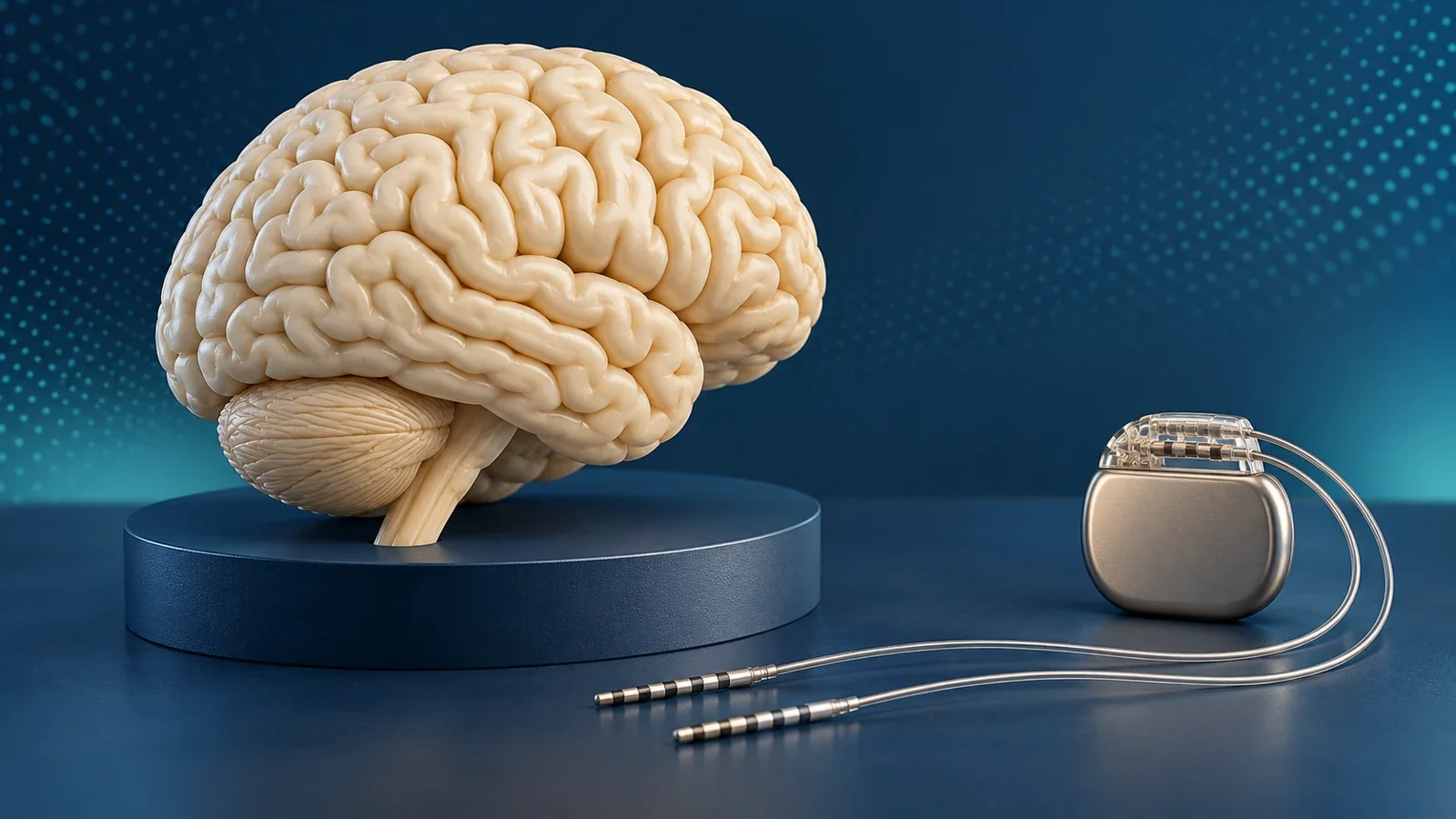
What is deep brain stimulation?
Deep brain stimulation delivers electrical impulses through electrodes in selected brain regions, aiming to modify particular circuits in selected diseases. The system includes electrodes, subcutaneous connections and a pulse generator. Programming adjusts stimulation individually.[1]
It does not add cells or replace lost neurons. In Parkinson's it may help manage certain movement symptoms, without stopping progression or resolving everything. Identify the target beforehand: tremor may dominate in one person, fluctuations or involuntary movement in another.[2]
Can it treat every neurological disease?
No. Diagnosis and selection limit use. Parkinson's, essential tremor and certain dystonias need different pathways. Epilepsy stimulation has different targets and criteria. This page concerns movement-disorder assessment, not promotion of investigational uses as routine care.
Who might be considered?
Disabling fluctuations, involuntary movements or some resistant tremors despite suitable Parkinson's medicines may prompt assessment. Different parkinsonian syndromes do not share identical results. Diagnosis should be reviewed by an experienced movement-disorder neurologist.[3]
Duration and age alone do not decide. Assess medication response, walking, balance, speech, cognition, mental health and circumstances. Advanced memory problems, uncontrolled psychiatric conditions or serious other illness may affect decisions. Family support matters for monitoring.
Why assess medicine response?
Expert comparison of medicated and unmedicated periods helps identify potentially responsive symptoms. Patients should not independently stop treatment for testing. The centre plans safety and conditions. Tremor may need separate assessment; one test does not define all expectations.[2]
Team assessment before surgery
A brain stimulation implant decision is not based on imaging alone. Functional neurosurgery, neurology, neuropsychology and psychiatry where necessary should work together. Assessments of memory, attention, decision-making and mood contribute to understanding postoperative needs and possible risks.[4]
Brain MRI is used for anatomical planning and for investigating other possible problems as part of the individual assessment. Anaesthetic review covers cardiac and respiratory conditions, bleeding, medicines and operations. Technical implantation conditions matter. Reliable review access is an essential decision component, not a minor later detail.
Expected gains should be defined through the person's own everyday life. Examples include reducing the effect of tremor while eating or managing movement fluctuations during the day. Such specific goals are more informative than an undefined expectation of improvement. They help clarify which difficulties the treatment is intended to affect and which may remain. Being found unsuitable for an operation is also a possible result of this assessment, rather than an indication that the assessment had no purpose.
How does it relate to non-surgical care?
Medication optimisation, rehabilitation, speech and swallowing assessment, exercise and daily support form part of Parkinson's management. Device-assisted medication delivery may suit some people. Neurology teams discuss burdens and benefits; surgery is not a compulsory next step for everyone.[3]
Medicines may remain necessary afterwards. The team plans changes. Another patient's discontinuation does not justify changing your prescription. Movement improvement does not establish equal sleep or cognitive improvement.
The general operative framework
DBS surgery places electrodes in planned targets and connects them to a subcutaneous generator. Disease and goals determine targets. Imaging and planning assist. Selected stages may use awake assessment or general anaesthesia according to the individual plan and centre.[1]
Placement does not mean settings remain fixed permanently. Activation timing depends on protocol, healing and clinical condition. Hospital stay and activity return have no universal duration; extent and other diseases matter.
Why is programming important?
After surgery, settings and medication are reviewed together. Device programming balances symptom reduction against speech, balance or sensory effects. The first setting need not be final. Several visits and later adjustments may be required.[5]
Use only taught controller functions. Rechargeable systems require charging instructions; others need battery monitoring. Lifespan depends on settings and device. Future generator replacement is another possible procedure to discuss initially.
Can another centre provide follow-up?
Whether follow-up can continue at another centre depends on its experience, programming facilities and the particular device. Keep the operative report, implant card, electrode and generator details and records of current settings. These documents help the next team understand the system already in place. Concentrating only on an operation date before establishing monitoring arrangements leaves an important part of long-term treatment unplanned. The question of access should therefore be raised before implantation rather than postponed until a change of centre becomes necessary.
Risks and benefit limitations
Brain haemorrhage, infection, seizures, wound or hardware problems and anaesthetic complications are possible. Lead or connection issues may require surgery. Some effects respond to reprogramming, but not every adverse outcome reverses. Discuss speech, balance, mood and cognition individually.[1]
Randomised studies report motor and quality-of-life benefits in selected advanced Parkinson's patients, alongside serious surgical adverse events. Results cannot transfer to everyone with different diagnosis, response or selection. Benefit in research does not establish identical effects on every symptom.[6]
Balance, freezing, speech and cognitive symptoms should each be discussed separately in terms of how much they might change. The disease's natural course can continue. Instead of judging outcome from a video of tremor alone, assess daily function, unwanted effects, medication requirements and the person's priorities together. A change in one movement symptom should not be assumed to describe the entire experience of treatment or every difficulty in everyday life.
Everyday precautions
Inform teams before MRI, surgery and electrical procedures. Verify exact model and components for MRI conditions. Keep the implant card accessible. Follow written manufacturer and centre advice on airport security and device interactions.[5]
Report wound discharge, redness, fever, new neurological signs or unexpected device behaviour. Sudden severe headache or weakness needs emergency assessment. Waiting for a routine settings appointment may be inappropriate.
What should you ask before deciding?
Patients can ask why the proposed brain target was selected, which symptoms may change and which may remain. The frequency of programming appointments, support needed to use the equipment and possible later generator replacement should also be discussed. Improvement in a personally important daily task and a change in an examination movement score may mean different things. Decisions should therefore include expectations as well as test results. If surgery is deferred or another option is chosen, clarify how monitoring will continue. Patients and relatives can ask for unfamiliar terms to be explained again so that the decision rests on understandable information.[4]
Deep brain stimulation assessment in İzmir
Reviewing diagnosis and current treatment together is the starting point. Neurosurgical assessment may include referral to functional neurosurgery and movement-disorder teams. Op. Dr. Ozan Ganiüsmen can discuss symptoms and investigations; specialised implementation and long-term follow-up require separate assessment.
Scientific and Institutional Sources
- AANS — Deep Brain Stimulation
System, surgical principles and neurological or hardware risks
- Oxford University Hospitals — DBS pre-operative information for people with Parkinson’s disease
Symptom targets, medication response and limits regarding disease progression
- NICE — Advanced therapies: Parkinson’s disease in adults
Medication optimisation and surgical alternatives in Parkinson’s care
- NICE — Deep brain stimulation for Parkinson’s disease: recommendations
Selected patients, experienced teams, consent and clinical oversight
- Cambridge University Hospitals — Information for DBS patients leaving hospital
Programming, post-discharge monitoring and everyday safety
- Bilateral deep brain stimulation vs best medical therapy for patients with advanced Parkinson disease: a randomized controlled trial
Benefit-risk balance in selected advanced Parkinson’s patients; not generalised to other diseases