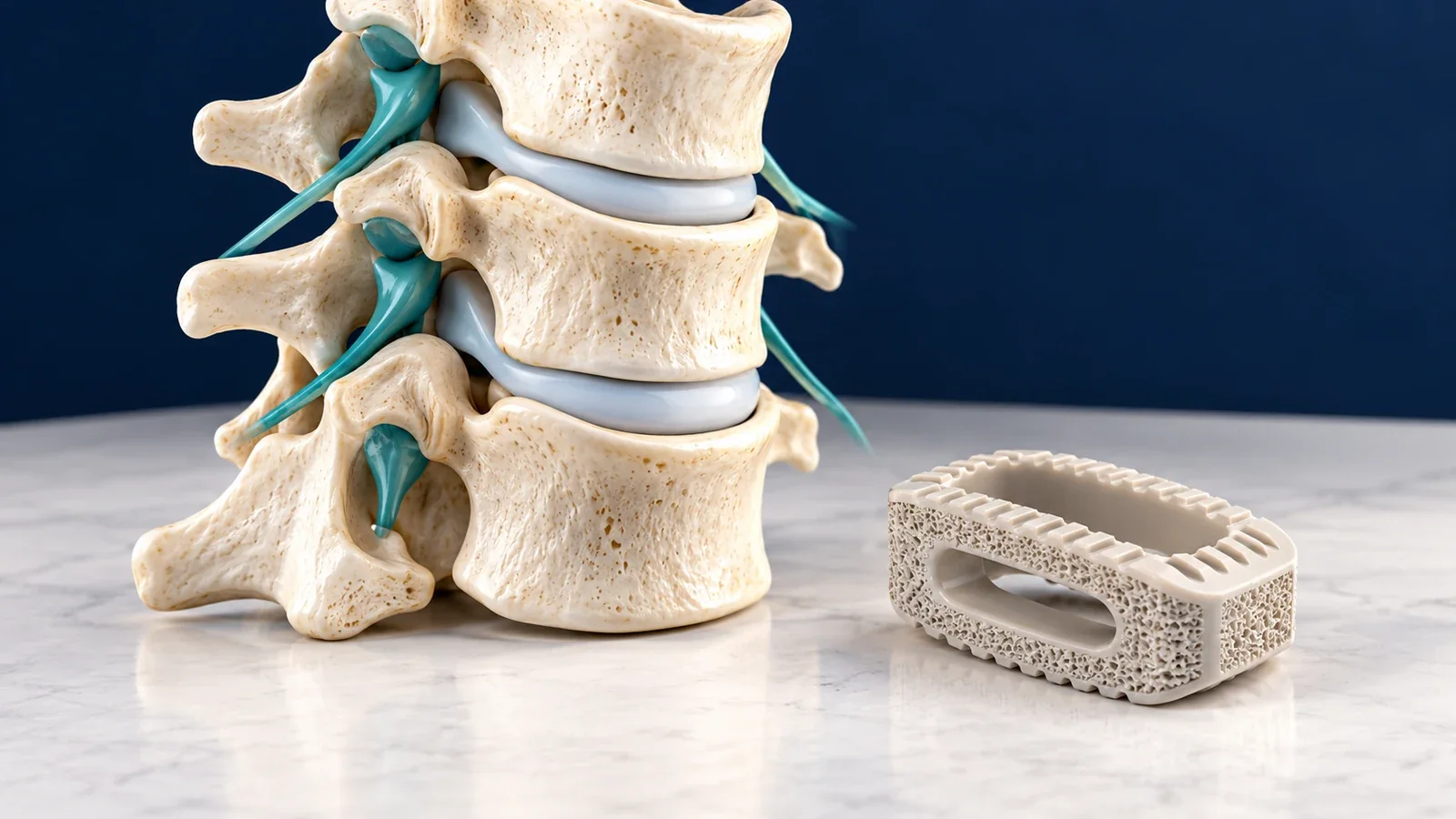
What are cervical discectomy and fusion?
Cervical discectomy and fusion removes disc tissue contributing to pressure on a nerve root or spinal cord in the neck and aims to create bony union between the relevant vertebrae. When performed from the front, it is called anterior cervical discectomy and fusion, abbreviated ACDF in medical records. Scope varies with disease location and affected levels.
Discectomy and fusion are not the same concept. Discectomy describes disc removal, while fusion describes joining particular vertebrae. Some operations combine them. Not everyone with neck pain needs this intervention. The cause of symptoms and neurological involvement must be assessed first.[1]
Which problems might lead to consideration?
Nerve-related pain radiating from the neck into an arm, progressive weakness or spinal cord findings may be important in surgical assessment. Persistent symptoms affecting daily life despite suitable non-surgical approaches are also considered. A decision is not based on one pain description or an MRI report alone. Agreement between symptoms and compression location is investigated.
Nerve root and spinal cord involvement
Nerve root involvement may cause pain, numbness and weakness in particular arm or hand areas. Spinal cord involvement may alter hand dexterity, balance when walking or other neurological functions. The conditions may require different timing and treatment options. Examination clarifies which structure relates to similar-looking symptoms.
Degenerative cervical myelopathy guidance emphasises severity and clinical progression in decision-making. Spinal cord compression on imaging and clinical myelopathy are different assessments. Guidance should not be used as an automatic surgical criterion independently of individual examination.[2]
What is examined before choosing a method?
The consultation addresses symptom onset, movement-related changes, hand function and walking differences. Strength, sensation and reflexes are examined. MRI provides information about nerves and discs. Further investigations may assess bone, movement or other nerve problems when needed.
Affected level numbers, alignment, stability and previous interventions may influence selection. The same disease name may lead to different surgical plans. Multiple imaging changes do not require treating every finding in one operation. Operative extent should follow clinical need.
The main principles of discectomy and fusion
An anterior approach reaches the cervical spine surgically from the front. The relevant disc and contributing compressive structures are assessed to create space for nerve tissue. Graft or suitable spacers may support the disc space and bony union. Some plans also use plates and screws.
What does using an implant mean?
Materials used in cervical fusion support the intended biological bony union. Implant placement does not mean fusion is complete at that moment. The process is assessed over time. Function, rationale and possible problems should be explained without brand-based superiority claims.
Technical details, materials and approach extent vary individually. This article does not recommend a particular device or identical procedure for everyone. Preoperative discussion can cover the target level, expected changes and the possible need to alter technique.
What other treatment options exist?
Depending on clinical circumstances, monitoring, medicines and physiotherapy may be considered. Some people may be candidates for other operations or disc replacement. Options are not compared solely by incision location or device name. Disease characteristics, compression location and spinal structure are considered together.
Disc replacement is not a universal substitute for fusion. Fusion is likewise unnecessary for every neck symptom. Discussion should address personal priorities, conditions for monitoring without intervention and the significance of neurological changes. Symptoms that could alter timing should be explained separately from routine review intervals.
How should scientific publications be interpreted?
A randomised trial in cervical radiculopathy compared surgery plus physiotherapy with physiotherapy alone. Long-term assessment concerned a defined patient group and operation. It does not establish that every neck pain requires surgery or that everyone will experience the same effect.[3]
Pain, function and repeat intervention are different study outcomes. A change in arm pain alone should not be equated with improvement in every everyday function. Findings cannot become personal success promises without considering selection and follow-up. Evidence can inform the reasons discussed for options.
Possible risks and surgical limitations
Discussion includes infection, bleeding, nerve or spinal cord injury, cerebrospinal fluid leakage and persistent symptoms. Swallowing and voice problems are particularly relevant to an anterior neck approach. Failure of fusion, implant problems and later disease at other levels may also be considered.[1]
Symptoms from longstanding nerve involvement may not disappear completely. The individual should understand whether the aim is to improve existing functional loss, limit progression or reduce pain. An outcome cannot be predicted without examination and treatment details.
What information should be shared before surgery?
Tell the team about regular medicines, allergies, previous neck surgery, swallowing or voice problems, smoking and other health conditions. Anaesthetic assessment and necessary tests are arranged. Relevant doctors manage blood thinners according to individual risks. This text does not recommend stopping medicines or starting supplements independently.
Fasting, transport and home support should be clarified through the institution's instructions. Ask whether a collar is needed and, if so, how to use it. Another patient's device or duration should not be adopted as your own care plan.
What is monitored after surgery?
Reviews assess dexterity, strength, sensation and walking alongside arm pain. Imaging where needed can help assess alignment and fusion. There is no single timetable for work, driving or exercise. The operation and personal function guide recommendations.
New weakness, rapidly increasing neck swelling, breathing difficulty, marked swallowing problems, fever or wound issues require prompt healthcare assessment. Sudden severe symptoms need emergency help. Discharge instructions should distinguish monitoring mild symptoms from urgent situations.
Common questions about fusion
How is bony union assessed?
Assessment does not rely only on pain relief. Examination, function and necessary images are interpreted together. Few symptoms do not prove complete fusion, and pain for a period does not alone establish a fusion problem. The doctor arranges further investigations when uncertainty arises.
Are movement restrictions the same for everyone?
The number of operated levels, support used and neurological status may affect movement advice. Online neck exercises or collar durations should therefore not be adopted directly. Individual follow-up plans explain permitted head and neck movement.
Persistent numbness can be recorded separately from arm pain changes. A new symptom differs from continuation of an old one. Describing onset and effects on daily function helps review. Findings that could change decisions should be reported promptly.
Assessment for cervical disc surgery in İzmir
A consultation about cervical disc surgery brings together previous images, treatments and changes in neurological symptoms. Details of Op. Dr. Ozan Ganiüsmen's practice in Alsancak, İzmir are on the contact page. This article explains the general approach; suitability for discectomy and fusion requires individual medical assessment.
Scientific and Institutional Sources
- AANS — Cervical Spine
Professional society patient information; cervical surgery and possible risks
- Fehlings et al. — Clinical Practice Guideline for Patients With Degenerative Cervical Myelopathy
Clinical guideline; assessment based on myelopathy severity and progression
- Engquist et al. — A 5- to 8-year randomized study on the treatment of cervical radiculopathy
Randomised research; surgery and physiotherapy compared in selected radiculopathy patients
- UCLH NHS — Single level anterior cervical discectomy
Institutional patient information; fusion process and approach limitations