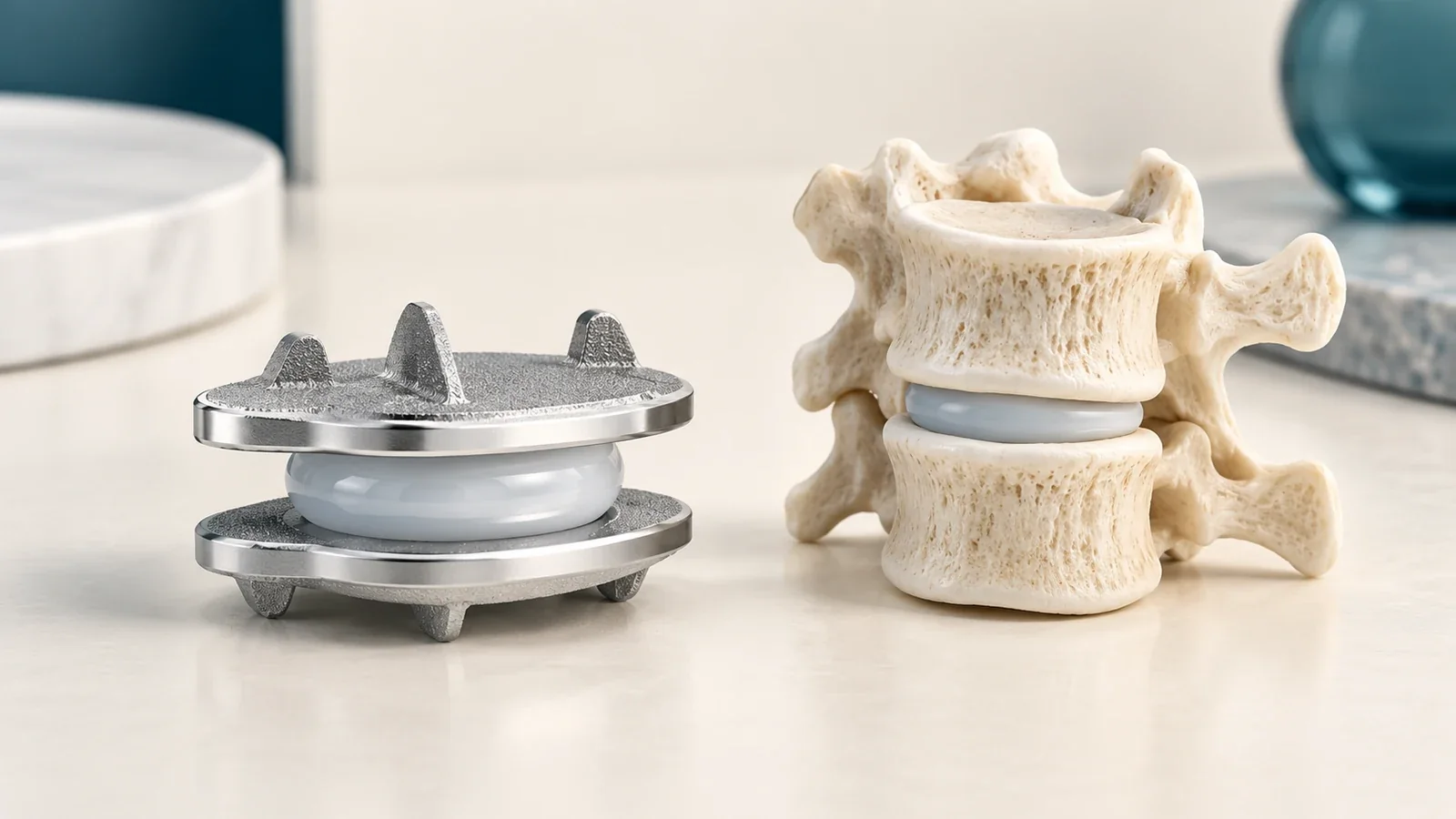
What is cervical disc replacement?
Cervical disc replacement involves placing an artificial joint-like implant in place of a removed neck disc to preserve movement in selected patients. It is also called cervical disc arthroplasty or artificial cervical disc surgery. The aim is to maintain movement at the operated level while addressing pressure on nerve tissue where appropriate. A device's name alone does not determine suitability.
Fusion aims for bony union, whereas disc replacement aims to preserve movement. Selection cannot depend on a wish to retain movement alone. Cervical structure, the cause of compression, joint condition and personal health are examined. Replacement is not a universal solution for every cervical disc herniation.[1]
When might it be considered?
When surgery is needed for certain cervical disc diseases involving nerve root or spinal cord compression, replacement may be an option. The first question is whether surgery is genuinely required. The possibility of using an implant does not justify operating when non-surgical monitoring is appropriate. Neurological findings and symptom progression are central to the decision.
Structural factors influencing selection
Alignment, movement, facet joint changes and bone quality may be assessed. Instability, substantial deformity or advanced degeneration may affect suitability. Previous operations and the number of affected levels also matter. Their significance is explained through individual examination and images; age alone does not determine the decision.
Use criteria for one implant may differ from another. General online information cannot establish that every replacement device can be used under identical conditions. A doctor must assess intended use and requirements for the proposed device. This page does not direct preference towards any product or brand.
How is preoperative assessment performed?
Information is gathered about arm pain, numbness, weakness, hand dexterity and walking. Neurological findings are compared with imaging changes. MRI provides information on nerves and discs; other investigations may assess bone or movement when necessary. No single imaging sequence is compulsory for every patient.
Further bone health assessment depends on history and the operative plan. Regular medicines, allergies and previous anaesthetic experiences should be reported. Known reactions to metals or implants should be explained. This helps select an appropriate method, but no test alone eliminates every risk.
The general approach to cervical disc arthroplasty
The cervical spine is reached through an appropriate surgical route, the relevant disc is removed and pressure on nerve structures is assessed. An artificial disc of planned size and position is placed in a suitable space. Details vary with anatomy and the system used. This is not an operative instruction or an identical plan for everyone.
What does preserving movement mean?
Cervical disc arthroplasty aims to retain a degree of movement at the operated level. Intended movement and the relief a person feels after surgery are different outcome measures. Changes developing around the implant may affect movement over time. Follow-up considers device position, spinal relationships and clinical status together.
How are disc replacement and fusion compared?
Fusion aims for bony union between the relevant vertebrae, while replacement is a movement-preserving option. Certain spinal characteristics may favour one approach. Comparisons in different patient groups or different numbers of levels should not be expected to yield identical results. Operative extent and personal priorities inform the decision.
Disc replacement cannot be claimed to prevent disease at adjacent levels in every patient. Many factors may contribute to adjacent-level changes. Reoperation rates in studies also relate to the device, patient selection and follow-up. Results from one trial should not be applied uniformly to all products and patients.
How should long-term research be interpreted?
A ten-year publication following participants at three centres from a randomised trial compared cervical disc arthroplasty with anterior discectomy and fusion. Findings concern the selected population and device system. Such research can inform discussion of long-term options but does not predict an individual's outcome.[2]
Another long-term randomised follow-up examined imaging outcomes including range of movement and adjacent segment changes. Radiological changes are not synonymous with pain or daily function. Interpretation requires knowing which outcome was measured. Participants lost to follow-up and the scope of research may also affect assessment.[3]
Positive publications do not establish that a person needs surgery. Indication and suitability come first. Without replacing the individual consultation, research can support discussion of potential benefit, uncertainty and alternatives.
What are the possible risks?
Alongside infection, bleeding, nerve or spinal cord injury, swallowing and voice problems, implant-specific issues may occur. Discussion may include device migration, subsidence into bone, reduced movement or bone formation around the implant. Some people may need further intervention. Personal risks should be related to health and the operative plan.[1]
An implant does not eliminate every source of neck pain. Joint or muscle problems may persist. Symptoms from longstanding nerve involvement may follow a different course. The expected change in each symptom should be explained beforehand.
How are preparation and daily arrangements planned?
The team plans medicines, tests, fasting and anaesthetic assessment. Patients should not stop regular treatment independently. Home support, transport and time away from work can also be discussed. Recovery duration cannot be determined precisely from the method's name alone.
Individual instructions guide collar use, exercise and driving. Another patient's experience with the same implant does not create a universal care programme. Questions should be resolved before surgery or at discharge. Patients should know how to reach the team for unexpected symptoms.
Why does postoperative follow-up continue?
Reviews assess neurological status, pain and daily function. If needed, imaging examines the implant and spine. Being symptom-free for a period does not make future review unnecessary for everyone. Intervals depend on the clinical course and system used.
New weakness, marked breathing or swallowing difficulty, rapidly increasing swelling and wound problems need prompt assessment. Sudden or severe symptoms require emergency help. The team should explain which problems can wait for routine review and which require earlier care.
What can you ask about living with an implant?
Should implant information be kept?
Keep operative implant records and any device card. Share this information with the relevant team before later imaging or procedures. Safety assessment, particularly before MRI, relates to device characteristics and the institution's practice. Identical conditions should not be assumed for every implant.
Does follow-up depend only on pain?
Pain relief is important but alone does not adequately describe device position or neurological status. Necessary checks depend on the individual's clinical course. Function, hand use and any walking symptoms may also form part of assessment.
When everyday movements can resume depends on operative scope. A movement-preserving implant does not mean immediate unrestricted neck movement or heavy activity is appropriate. Understanding the reasons for individual instructions and asking about unclear advice are part of care.
Cervical disc replacement assessment in İzmir
Assessment for cervical disc herniation treatment in İzmir can consider the individual suitability of replacement, fusion and non-surgical options separately. Op. Dr. Ozan Ganiüsmen's practice address is on the contact page. This information does not recommend a particular implant or surgery for an individual; selection requires clinical findings.
Scientific and Institutional Sources
- AANS — Artificial Cervical Disc Surgery
Professional society patient information; candidate selection, aims and risks
- Cervical Disc Arthroplasty vs Anterior Cervical Discectomy and Fusion at 10 Years: Results From a Prospective, Randomized Clinical Trial at 3 Sites
Long-term follow-up of randomised research; specific device and selected patient group
- Twenty-Year Radiographic Outcomes Following Single-Level Cervical Disc Arthroplasty: Results From a Prospective Randomized Controlled Trial
Long-term randomised follow-up; radiological outcomes not equated with clinical outcomes