What is hemifacial spasm?
One-sided contractions linked to the facial nerve
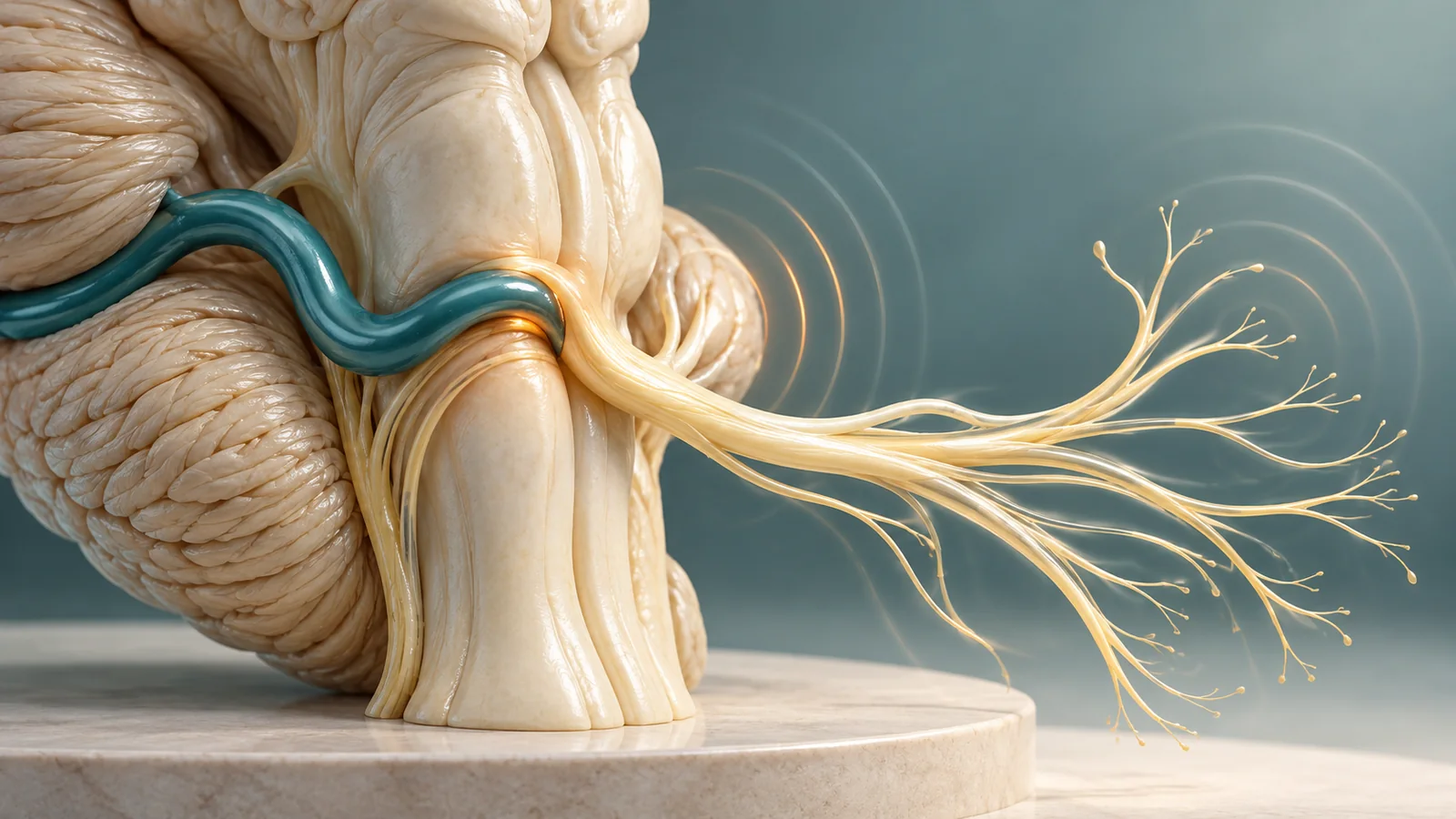
Hemifacial spasm causes involuntary, repeated contractions on one side of the face. It commonly starts around an eye and can spread to cheek and mouth muscles on the same side. Usually painless, it may nevertheless affect vision, reading, speaking and social life. It involves the seventh cranial nerve controlling facial muscles. Trigeminal neuralgia mainly concerns pain and a different nerve: the conditions are not interchangeable even when a similar procedure is discussed. Vascular compression near the facial nerve's brainstem exit is a common mechanism; other structural causes may need investigation. Not every eyelid twitch is hemifacial spasm. Distribution and progression should be assessed before attributing it solely to stress or fatigue. Understanding clinical features precedes interpreting an imaging report.[1][2][3]
Good and bad periods may occur. Assess treatment over time through function and the patient's experience rather than judging from one day's appearance.
Distinguishing similar conditions
Eyelid twitching and blepharospasm
Mild eyelid twitching may be brief and limited. Blepharospasm is a different movement disorder usually affecting both eyes. Hemifacial spasm can spread to other muscles on the same half of the face. Associated movements after previous facial palsy also need separate assessment. Tics, certain seizures and other movement disorders may resemble it. Assessment of one-sided facial contractions considers onset age, spread, duration and daily effects. Persistence during sleep and relationships to voluntary movement can help. A short video may be useful when contractions are absent during examination, but cannot establish diagnosis alone. New facial weakness with limb or speech problems requires urgent assessment rather than attribution to known spasms. Psychological and social burden also deserve consideration in the discussion.[1][2][3]
What does diagnosis involve?
Examination, MRI and selected further tests
Examination assesses distribution, facial strength and other cranial nerves. MRI may investigate vascular relationships and alternative structural causes. Visible vessel contact still needs agreement with clinical findings. Selected patients undergo electrophysiology; not everyone needs the same tests. Differential diagnosis directly affects treatment. Bilateral eye closure, associated movements with smiling and contractions involving other muscle groups need different interpretation. Review previous facial palsy, trauma, procedures and medicines. Record benefits and adverse effects of earlier injections. Descriptions and videos provide additional information for symptoms not present at the appointment. Neither distress about contractions alone nor vascular contact alone should determine surgery. The team considers the whole clinical picture, including how function is affected and whether the proposed treatment addresses the identified problem.[1][2][3]
Non-surgical options
The purpose of botulinum toxin
Botulinum toxin injections into affected muscles can reduce contractions. They do not remove vascular contact, and temporary effects may require repeat treatment. A specialist selects sites and amounts for the pattern. Drooping eyelid, double vision, dry eye or temporary facial weakness can occur. Previous response and duration inform subsequent planning. This article gives no individual doses. Medicines may be considered selectively, with variable benefit and adverse effects. Observation can be discussed for mild symptoms according to preference. Goals include keeping the eye open, reading and social interaction, not merely reducing muscle movement. Discuss expected effects, repeat treatment and possible weakness openly. Recording changes between sessions can help distinguish duration of benefit from unwanted effects and inform the next review.[2][3][4]
Microvascular decompression
Surgery addressing vascular compression
In selected patients, microvascular decompression adjusts the relationship between facial nerve and compressing vessel. It is open surgery through the back-side of the skull, different from injections, and needs assessment of general health. Surgical risks include hearing impairment, facial weakness, cerebrospinal fluid leakage, infection, bleeding and other neurological problems. Contractions may not resolve immediately or may recur. Intraoperative monitoring can help but cannot guarantee freedom from complications. Decisions depend on severity, previous treatment, MRI and risk preferences. Quality-of-life effects matter alongside the burden of surgery. Other centres' case series cannot guarantee an individual's result. Selection requires a team with relevant experience and support, with the benefits, limits and alternatives explained in relation to the patient's own circumstances.[1][5]
Follow-up and daily life
Preparing for consultation in İzmir
Review contraction frequency, eye closure, facial strength and everyday effects. Significant dry eye or visual problems after injection require assessment. Report postoperative new hearing loss, facial weakness, fever or wound fluid. Sudden severe neurological symptoms need emergency help. New complaints should not automatically be attributed to the previous diagnosis. Bring MRI images, short videos, injection dates and earlier results to Op. Dr. Ozan Ganiüsmen in İzmir. Neurology and functional neurosurgery assessment may be coordinated. Discuss work, reading, driving and social goals. Success is not reduced to counting contractions during a few examination minutes: eye use, adverse effects and daily changes matter together. Follow-up can consider both the patient's observations and practical examples from activities affected by spasms or treatment.[1][2][4][5]
Scientific and Institutional Sources
- St George’s NHS — Hemifacial spasm
One-sided spasm, facial nerve, MRI and microvascular decompression
- Guy’s and St Thomas’ NHS — Blepharospasm and hemifacial spasm
Distinguishing blepharospasm and treatment
- NINDS — Myoclonus
Peripheral myoclonus framework and botulinum toxin
- Northern Care Alliance NHS — Botulinum toxin injections for hemifacial spasm
Injection aims and adverse effects
- Operative Complications of Microvascular Decompression for Hemifacial Spasm: Experience of 1548 Cases
Primary surgical series; risk categories without individual success claims