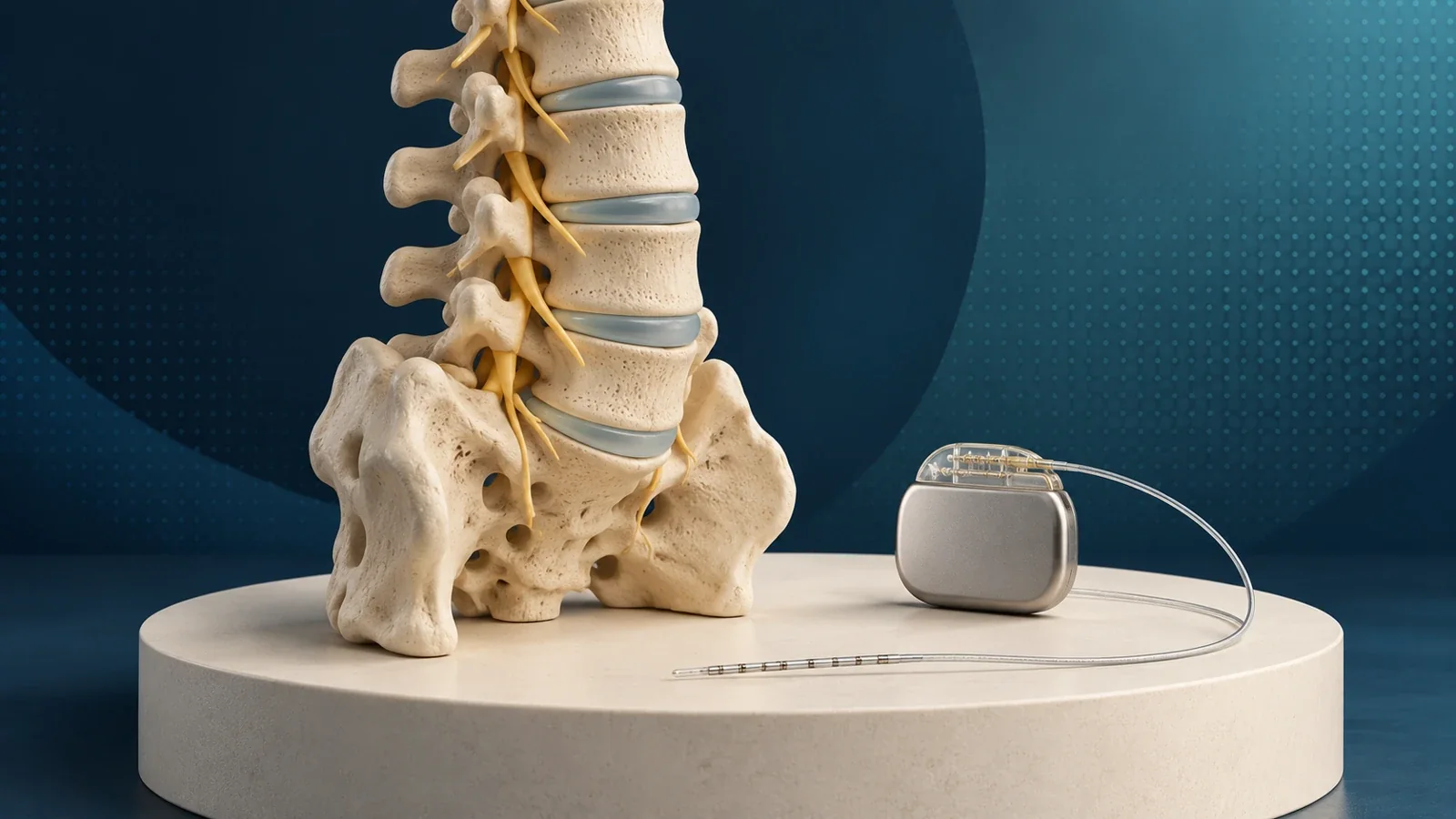
What is spinal cord stimulation?
Spinal cord stimulation is neuromodulation using electrical impulses to alter pain transmission in certain chronic conditions. Sometimes called a pain implant, it is not a reservoir of analgesic medicine. Electrodes, connecting leads and a pulse generator form the system. The aim is to reduce everyday pain burden in suitable patients, rather than regenerate damaged tissue or correct every structural spinal problem.[1]
Nerve-related pain may feel burning, electric or stabbing without touch or movement. Description alone does not justify implantation. Assess source, neurological findings and previous care together. Mechanical back pain, widespread pain and compression requiring surgery should not be grouped as identical candidates.
Are electrodes placed inside the spinal cord?
Standard electrodes lie in the epidural space outside the covering, not within cord tissue. Stimulation influences pain-message processing. Devices and waveforms differ: some produce tingling, others no noticeable sensation. Selection relates to anatomy and goals.[2]
Who might be assessed?
Some people with persistent functional loss from neuropathic pain despite suitable non-operative care may be candidates. Persistent nerve pain after spinal surgery and complex regional pain syndrome are possible assessment reasons. Previous surgery alone does not establish device need; the cause of continued pain requires reassessment.[3]
Finding a problem on imaging that could be addressed by another operation, an infection or a newly developing neurological deficit may change the assessment pathway. Progressive weakness, new bladder control impairment and marked numbness should not be considered only within pain management. The device is not a substitute for investigating a disease that requires prompt attention. Understanding the reason for persistent pain therefore comes before selecting equipment, even when a patient has already undergone a spinal operation.
Which team decides?
An experienced multidisciplinary chronic pain and neuromodulation team assesses suitability. Neurosurgery, pain medicine, psychology and rehabilitation may contribute according to need. Psychological consultation does not question whether pain is real; it explores expectations, engagement needs and support.[4]
What options exist without an implant?
Medication review, tailored movement, physiotherapy, sleep and coping support may form part of care. Targeted injections or other surgery may suit selected cases. Underlying disease and function matter alongside intensity. Record what was tried, for how long and with what result.[1]
Considering a pain stimulation implant does not end other support. Goals may be easier walking, daily tasks or rehabilitation participation. Medication reduction may be possible but cannot be promised. Do not stop prescriptions outside the medical plan after implantation.
How is trial stimulation assessed?
Suitable candidates may undergo a temporary trial before permanent implantation. Record walking, sleep, activities and personal goals alongside pain. The aim is to observe meaningful individual contribution. The team should explain criteria beforehand.[5]
Does a positive trial guarantee lasting benefit?
Relief during a temporary trial does not guarantee a long-term response. Electrode position, disease progression, programming and the person's living circumstances can affect results. Discuss the criteria defining a positive response and how follow-up would proceed after permanent implantation. If the trial is inadequate, deciding not to implant a permanent system is also a natural part of medical decision-making.
What is discussed beforehand?
Bring operative reports, current imaging, medicines and other implant details. Report blood thinners, diabetes, immune conditions, allergies and infections. Relevant doctors coordinate changes; patients should not decide independently.[2]
Preparation also covers the practical aspects of living with a permanent system. Charging requirements, use of the controller, carrying device information and access to reviews should be explained clearly. If managing technical equipment may be difficult, discuss what support can be arranged. Before signing consent, the patient should understand the possible benefit, alternatives and the right not to choose the method. Agreeing to implantation is therefore more than a decision about a single day in hospital; the ongoing requirements should be understandable from the start.
Permanent implantation and programming
Electrodes connect to a generator through subcutaneous leads. Type and access vary with anatomy and previous procedures. Placement takes place in suitable theatre conditions. This general explanation does not mean everyone undergoes an identical intervention.[3]
Surgery is the first stage; device programming follows. The team adjusts stimulation area and properties. Learn only permitted controls. Do not copy another patient's settings or online advice. Different stimulation sensations alone do not prove malfunction.
Possible risks and limitations
Infection, bleeding, wound problems and implant discomfort may occur. Lead migration, connection failure or inadequate effect may require intervention. Rare serious neurological complications belong in consent. Assess conditions and technique individually.[2]
Pain reduction can change over time. The device does not open stenosis, remove herniation or prove nerve repair. Studies differ in populations, devices and follow-up, so findings cannot be directly transferred to every cause or individual.[5]
Can MRI be performed?
Suitability depends on exact model, electrodes and manufacturer conditions. Show the implant card and verify beforehand. Inform teams before other surgery or electrical procedures. A new device does not permit every investigation without conditions.
Follow-up and everyday life
Attend wound and programming appointments. Movement limits, work and exercise follow team advice. Charging and replacement needs differ by system; one battery lifespan cannot describe every device.[6]
Fever, worsening wound redness or discharge, new weakness and sudden sensory change need prompt contact. Report changes in previous pain too. Investigate causes rather than assuming remote setting adjustments suffice.
What questions can be asked?
Will outcomes be measured only by a pain score?
A score does not capture everything. Longer walking or less interrupted sleep may matter even at the same intensity. Establish realistic, measurable everyday goals. Combine personal records with clinical assessment. Ask about function rather than only sensation while the device runs. Absent benefit prompts review of programming, source and other care components.[4]
What happens if the system is removed?
Infection, hardware problems or insufficient benefit may lead to consideration of removing or replacing the system. Removal itself requires assessment and surgical planning. The fact that a device can be removed does not make the initial intervention an insignificant decision. Long-term reviews, possible further procedures and access to the follow-up centre should all be discussed at the outset. If reviews might later be needed in another city, device documents and previous programming records should also remain available to that team.[6]
Spinal cord stimulation assessment in İzmir
Documenting pain cause and previous treatment is the starting point in İzmir. Neurosurgical assessment may support referral to pain and neuromodulation centres. Op. Dr. Ozan Ganiüsmen can discuss symptoms, investigations and expectations, with specialised teams and follow-up assessed separately. This page neither promises implantation for every applicant nor states that it is part of personal services.
Scientific and Institutional Sources
- AANS — Spinal Cord Stimulation
Pain source, non-surgical approaches and general aims
- Cambridge University Hospitals — Spinal cord stimulation
Device components, preparation, procedure and risks
- Leeds Teaching Hospitals — Spinal Cord Stimulation
Chronic nerve pain, permanent systems and programming
- Guy’s and St Thomas’ — Spinal cord stimulation
Multidisciplinary candidacy and comprehensive goals
- Evidence-based consensus guidelines on patient selection and trial stimulation for spinal cord stimulation therapy for chronic non-cancer pain
Selection and trial stimulation limitations; rates not generalised
- Royal National Orthopaedic Hospital — Frequently Asked Questions: Spinal Cord Stimulators
Living with devices, long-term care and review needs