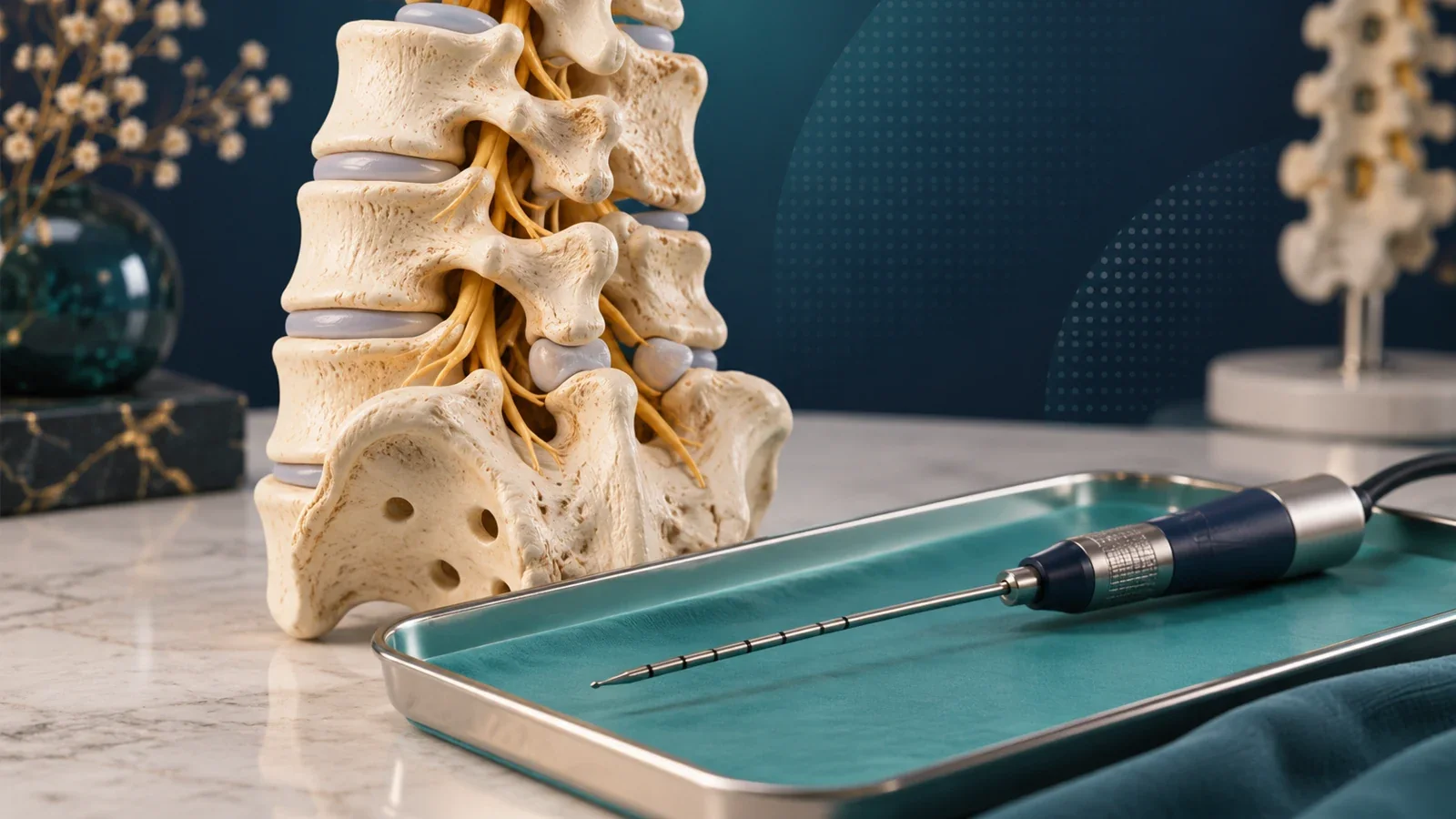
What is radiofrequency treatment?
Radiofrequency is a general term for energy applications used for different medical purposes. In pain medicine, it covers several distinct procedures. This article specifically discusses medial branch radiofrequency denervation, considered when lower back pain is thought to arise from the facet joints. Procedures targeting other regions, other nerves or the inside of a disc should not be regarded as the same intervention.
Facet joints are small joints at the back of the spine. Medial branch nerves, which help transmit pain signals from these joints, may be targeted in selected patients. Thermal radiofrequency produces a controlled heating effect. Its aim is to affect transmission from an identified pain source, rather than remove every structural change in the spine.[1]
Are radiofrequency, injections and surgery the same?
The difference between a diagnostic block and radiofrequency
A diagnostic or prognostic medial branch block involves placing local anaesthetic around the relevant nerves and assessing the change in pain. It may help estimate the likelihood of benefiting from a subsequent intervention. Radiofrequency is a separate procedure. Brief relief after a block does not reliably predict the outcome of the later procedure.
Thermal and pulsed techniques
Thermal and pulsed radiofrequency differ in their application and objectives. The word radiofrequency alone therefore provides insufficient information about a procedure. The nerve or structure being targeted, the planned technique and its relationship to the person's symptoms should be explained. This text does not make a shared effectiveness claim for every form of radiofrequency.
When might it be considered?
An intervention may be considered for some people with persistent lower back pain thought to originate in the facet joints, after non-surgical approaches have been assessed. The location of pain, its relationship to movement, response to previous treatments and effect on function are considered together. However, neither examination nor imaging alone can always establish that pain definitely comes from a facet joint.
NICE guidance on lower back pain and sciatica describes assessment for radiofrequency in selected cases of chronic lower back pain and the importance of response to a diagnostic medial branch block. This does not mean everyone with lower back pain should receive the same procedure. Suitability criteria should be explained in relation to clinical assessment and the proposed technique.[2]
Age, coexisting conditions, medicines, previous interventions and personal expectations are part of assessment. Rather than requesting a procedure by name alone, it is important to discuss the source of pain and the alternatives. Two people with pain in the same region may have different diagnoses and different treatment options.
How does it relate to lumbar disc herniation?
Facet joint pain and pain radiating down the leg because a disc affects a nerve root are different clinical conditions. They may coexist, but treating one does not demonstrate that the other has also resolved. Medial branch denervation cannot be described as an operation that removes mechanical pressure on a nerve root.
Weakness, new changes in bladder or bowel control and numbness around the saddle region may change the priority of assessment. Such symptoms require separate consideration when a pain procedure is planned. Pain relief and assessment of a neurological problem are not interchangeable. New, serious neurological changes require urgent assessment.
What is discussed before the procedure?
All medicines and known allergies should be reported. Blood-thinning or clotting-affecting medicines, signs of infection, diabetes and other health problems may influence planning. Stopping medicines or changing doses must be planned by the treating team and, where necessary, the prescribing doctor; patients should not make changes themselves.
Information to provide in advance
The team should be told about possible pregnancy, a pacemaker or other implanted electronic device, and problems during previous procedures. Precautions relating to imaging and energy application are assessed individually. These circumstances do not automatically require the same decision in every case; they are considered as part of safe planning.
Fasting, an accompanying adult and transport after the procedure depend on the technique used. Written instructions should be obtained from the relevant centre. Reusing old instructions for a different intervention may be inappropriate. The discussion should explain the aim, options and possible unwanted effects and allow the person to ask questions.
General information about the procedure
The procedure is performed in clinical conditions appropriate to the chosen technique. Imaging and necessary checks during the intervention may help identify the target. The team decides how local anaesthesia and any additional support will be provided. This explanation does not replace technical training or an individual procedure plan.
The target area and number of applications are determined after assessment. There is no single timetable for procedure duration, same-day discharge or returning to work the following day that applies to everyone. The centre's arrangements, the intervention and the person's health may affect planning. Patients should follow their own aftercare instructions.
What does scientific research show?
International consensus guidance on lumbar facet interventions reviews evidence on patient selection, diagnostic blocks, technique and outcome assessment. It identifies differences in methods and areas of uncertainty. A single success rate should therefore not be applied to all patients and all techniques.[1]
The MINT randomised trials compared adding radiofrequency to a standard exercise programme in defined patient groups and did not demonstrate a clinically important additional benefit in every group. This does not mean the method produces the same outcome for everyone; findings should be interpreted alongside selection criteria and study design. Publications cannot be used as a guarantee of individual benefit.[3]
Assessment should not focus only on a pain score. Daily function, medicines, activity levels and possible adverse effects also matter. The consultation can clarify whether study outcome measures match the person's own goals. Discussing the limits of scientific evidence is part of making a decision.
What are the possible risks?
Possible risks include a temporary increase in pain, tenderness or bruising at the entry site, infection, bleeding, altered sensation and unwanted nerve-related effects. Reactions to medicines are also considered. Because the frequency of a particular risk depends on the procedure and patient characteristics, no personal risk percentage is provided here.[4]
Increasing weakness, unexpected sensory loss, fever or a significant problem at the entry site after the procedure should prompt contact with the healthcare team. A severe or sudden neurological change requires urgent assessment. Whether it is appropriate to wait for a scheduled review should be discussed with the team according to the symptoms.
Follow-up and returning to everyday life
Symptoms, everyday function and movement plans are monitored after the procedure. Changes in pain vary between individuals; the expected benefit may not occur, or symptoms may recur. A repeat procedure is not arranged automatically. Reassessment considers the previous response, the nature of the pain and other possible causes.
Where appropriate, radiofrequency may be considered as part of a broader pain management plan. Exercise and rehabilitation are tailored individually. Before an assessment with Op. Dr. Ozan Ganiüsmen in İzmir, previous images, records of diagnostic blocks or interventions and a medicine list can be prepared. Contact details and the address are available on the contact page.
A common question: when is benefit assessed?
Follow-up timing is planned according to the technique used. Long-term conclusions should not be drawn from the pain level on a single day. Assessment considers previous symptoms, daily activities and possible adverse effects together. Unexpected symptoms should be assessed by the relevant team without waiting for a scheduled review. This approach distinguishes routine follow-up from an urgent need.
Questions to ask when discussing a decision
You can ask which structure is considered the pain source, what information the diagnostic block provides and the exact name of the planned procedure. It should be clear whether change will be assessed only through pain levels or also through everyday function. Options if the procedure is not performed and the follow-up plan also belong in the discussion.
Short-lived benefit from a previous intervention does not mean the same procedure will automatically be repeated. Reassessment reviews the source of pain and the person's health. Written preparation and aftercare instructions can be requested. Asking for unfamiliar terms to be explained is appropriate; a decision should not depend only on the procedure's name or another patient's experience.
Scientific and Institutional Sources
- Cohen et al. — Consensus practice guidelines on interventions for lumbar facet joint pain
Multidisciplinary consensus guidance; patient selection and procedural limitations
- NICE NG59 — Low back pain and sciatica: recommendations
Clinical guideline; radiofrequency selection criteria and medial branch blocks
- Juch et al. — Effect of Radiofrequency Denervation on Pain Intensity: The MINT Randomized Clinical Trials
Randomised clinical trials; limits of additional benefit
- Guy’s and St Thomas’ NHS — Facet joint radiofrequency denervation
Institutional patient information; technique-specific process and risks; endoscopic findings not generalised to all applications