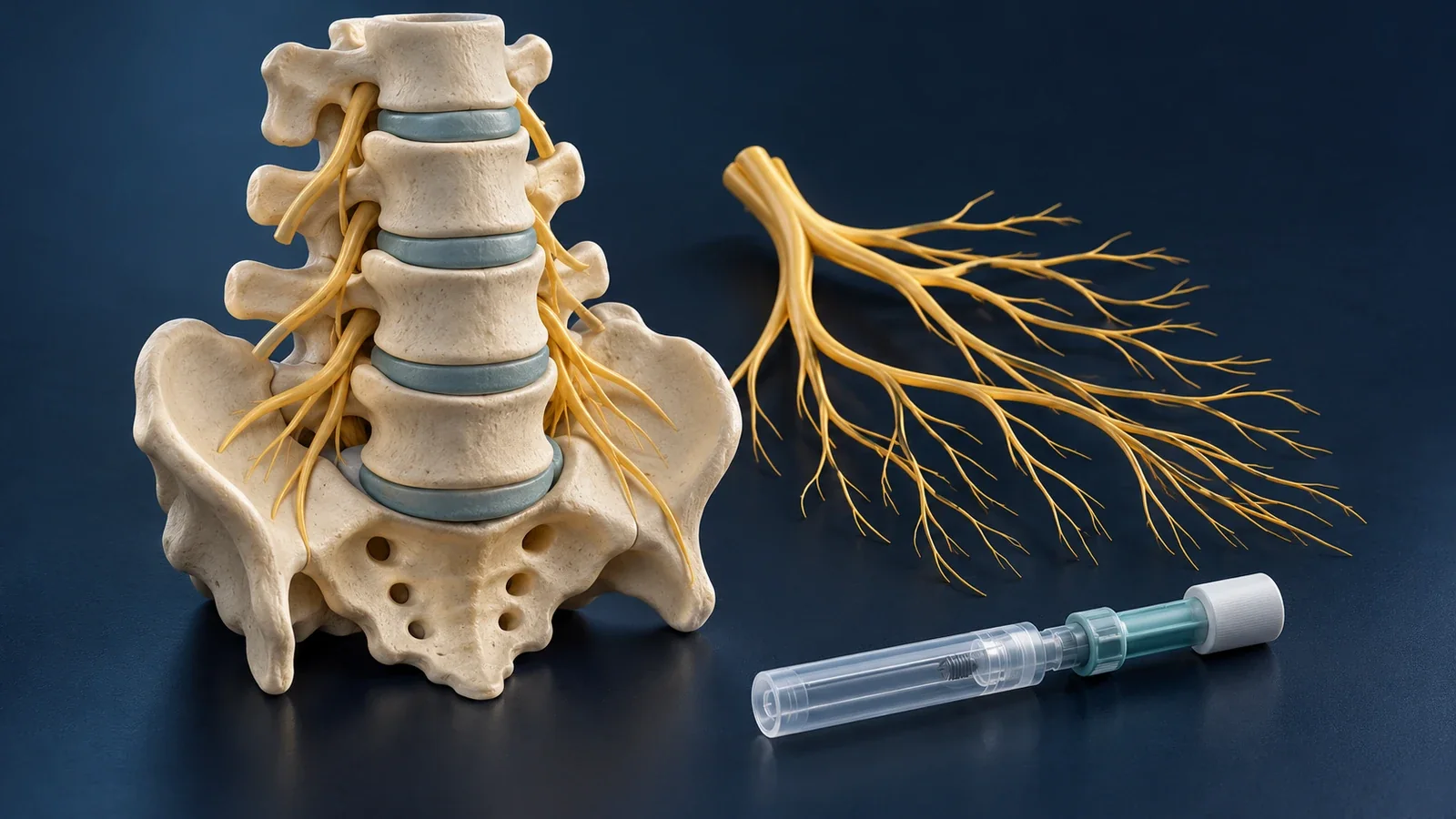
What is a medial branch block?
A medial branch block places local anaesthetic around small nerve branches carrying sensation from facet joints at the back of the spine. It helps assess the relationship between pain and these joints in selected patients. It is not surgical nerve division or an injection into the joint. Targeting a medial branch can be one assessment step, but cannot alone explain every neck or lower back pain.[1]
Consideration depends on symptoms and previous treatment. Assessment asks about onset, movement-related changes, daily impact and neurological symptoms. Imaging can help assess other diseases, but facet changes alone do not establish the source. A proposed diagnostic procedure should address a clear clinical question.
What do diagnostic and prognostic mean?
What information is sought?
A temporary change in specific pain after local anaesthetic may indicate the target nerves' contribution. The procedure may therefore be called diagnostic or prognostic, helping estimate response to later treatment. NICE notes the importance of a positive diagnostic medial branch response before radiofrequency for chronic lower back pain. A positive block does not guarantee a later radiofrequency result.[2]
Establishing baseline pain and everyday activities for assessment may help. Patients should not attempt unfamiliar strenuous movement solely to test the response. The team explains safe activities and recording times. Notes may describe sitting, walking or a particular task alongside pain reduction. The purpose of this written record is to support the subsequent clinical consultation and make the response easier to discuss in concrete terms.
Limitations in interpreting results
No single test should be expected to remove every uncertainty in assessing facet-related pain. Spread to adjacent structures, daily variation, expectations and other pain sources can affect response. Sedation also requires consideration. False-positive and false-negative possibilities mean assessment should not be reduced to one brief yes-or-no question.[3]
Specialty guidance may differ on positive response thresholds and block numbers. Research selection criteria and everyday clinical objectives are not always identical. The approach used should be explained, rather than presenting one centre's protocol as a universal fixed standard. If uncertainty about the diagnosis continues, the clinical assessment and the available alternatives should be reviewed again rather than assuming the block has resolved every question.[3]
How does it relate to radiofrequency?
Block and denervation are different
A medial branch block evaluates a temporary local anaesthetic effect. Radiofrequency denervation applies controlled energy to selected branches. Aims, duration and risk profiles differ. Having a block does not make radiofrequency compulsory. Before making a decision, the person's pain, everyday function, available alternatives and expectations of the intervention are considered again together. These methods are explained as separate website topics.[1]
The randomised FACTS trial did not support facet blocks as ongoing treatment in themselves and separately examined their prognostic role for radiofrequency. Temporary test relief cannot be presented as long-term treatment success. Lasting results from a specified number of blocks should not be promised. Each procedure requires its own rationale and patient participation.[4]
When might other options take priority?
Non-surgical neck or back care can include suitable movement, tailored exercise and medicine assessment, with rehabilitation and other specialists where needed. Medial branch blocks are not the first step for every spinal pain. NICE does not recommend routine injections for lower back pain alone and separately identifies selected circumstances for radiofrequency assessment. The intervention must match the clinical question.[2]
Findings suggesting root compression, spinal cord involvement, fracture, infection or another disease take priority. Marked weakness or new bladder–bowel control problems cannot be addressed only through a pain block plan. Several sources may coexist. One procedure should not be expected to resolve everything, and diagnosis should not be narrowed solely according to injection response.
Preparation and consent
Report medicines, bleeding or clotting problems, allergies, diabetes, possible pregnancy and recent infection. Do not stop blood thinners without a doctor. Previous reports and pain responses help planning. Suitability is rechecked; report same-day fever or new health problems. Postponement may be necessary.[1]
Ask the centre about fasting, accompaniment, sedation and transport. Understand the expected temporary local anaesthetic effect. During the consent discussion, the possibility of obtaining no useful response, the other available options and possible complications are discussed alongside the benefit being sought. Explaining the diagnostic purpose clarifies what to record afterwards. Learn how to complete any record form before the procedure.
The procedure and possible risks
The procedure uses suitable sterile conditions and assessment of imaging support for locating the region. Identity and site are checked, skin prepared and the planned application made around target nerves. This is not a technical manual; angles, quantities and level selection require clinical expertise. Report unexpected pain or sensations during application.[5]
Entry-site tenderness, temporary pain increase, bruising or numbness may occur. Bleeding, infection, allergy and nerve injury are possible. Different anatomical regions, such as the thoracic spine, may involve additional regional risks. Assessment depends on imaging, medicines and health. Patients should understand that something called only a test is still a medical intervention.[1]
Why is a pain diary more than a score?
A number records intensity but does not capture every daily effect. Identifying two or three safe, ordinary activities limited beforehand can help follow-up. Examples include sitting, a short walk or standing up. The aim is consistent observation of function rather than provoking pain to test it.
Additional medicines, injection-site tenderness and unusual daily circumstances can also be noted. Changed analgesics or resting all day may affect interpretation. Following the team's instructions matters. New weakness or unexpected symptoms should not only be scored; contact the team immediately where needed. A diary does not replace emergency assessment.
Review connects response with personal goals. Brief relief alone does not make another intervention mandatory. Other treatments, preferences and clinical findings are considered together. Clear explanations help distinguish method names. A decision for radiofrequency still requires new consent and individual safety assessment.
Follow-up, diaries and assessment in İzmir
What information records the response?
Record where pain changed, when change began and how long it lasted. Extra pain medicines and unusual activities can affect interpretation. Distinguish usual pain from new site tenderness. The doctor combines these details with examination and investigations. Patients should not use block response to diagnose themselves or independently select the next procedure.
New weakness, fever, increasing local redness, unexpected severe pain or bladder–bowel changes need medical assessment. People researching medial branch blocks and radiofrequency in İzmir should understand the intended pain source. Neurosurgical consultation considers previous images, medicine lists and functional limitations together to establish an individual pathway.
Scientific and Institutional Sources
- Guy’s and St Thomas’ NHS — Facet joint medial branch blocks for diagnosing pain
Institutional patient information; procedure distinctions, preparation, risks and follow-up
- NICE NG59 — Low back pain and sciatica in over 16s: assessment and management
Clinical guideline; radicular pain, limits on routine injections and distinctions between medial branch blocks and radiofrequency
- Cohen et al. — Consensus practice guidelines on interventions for lumbar facet joint pain
Multispecialty consensus guideline; diagnostic and prognostic blocks and limitations of response interpretation
- Cohen et al. — Effectiveness of Lumbar Facet Joint Blocks and Predictive Value before Radiofrequency Denervation: FACTS
Randomised controlled trial; findings do not support blocks as lasting treatment; prognostic assessment
- South Tees Hospitals NHS — Facet joint medial branch blocks
Institutional patient information; block definition, individual preparation and monitoring; retrieved through search when the direct page temporarily returned 503