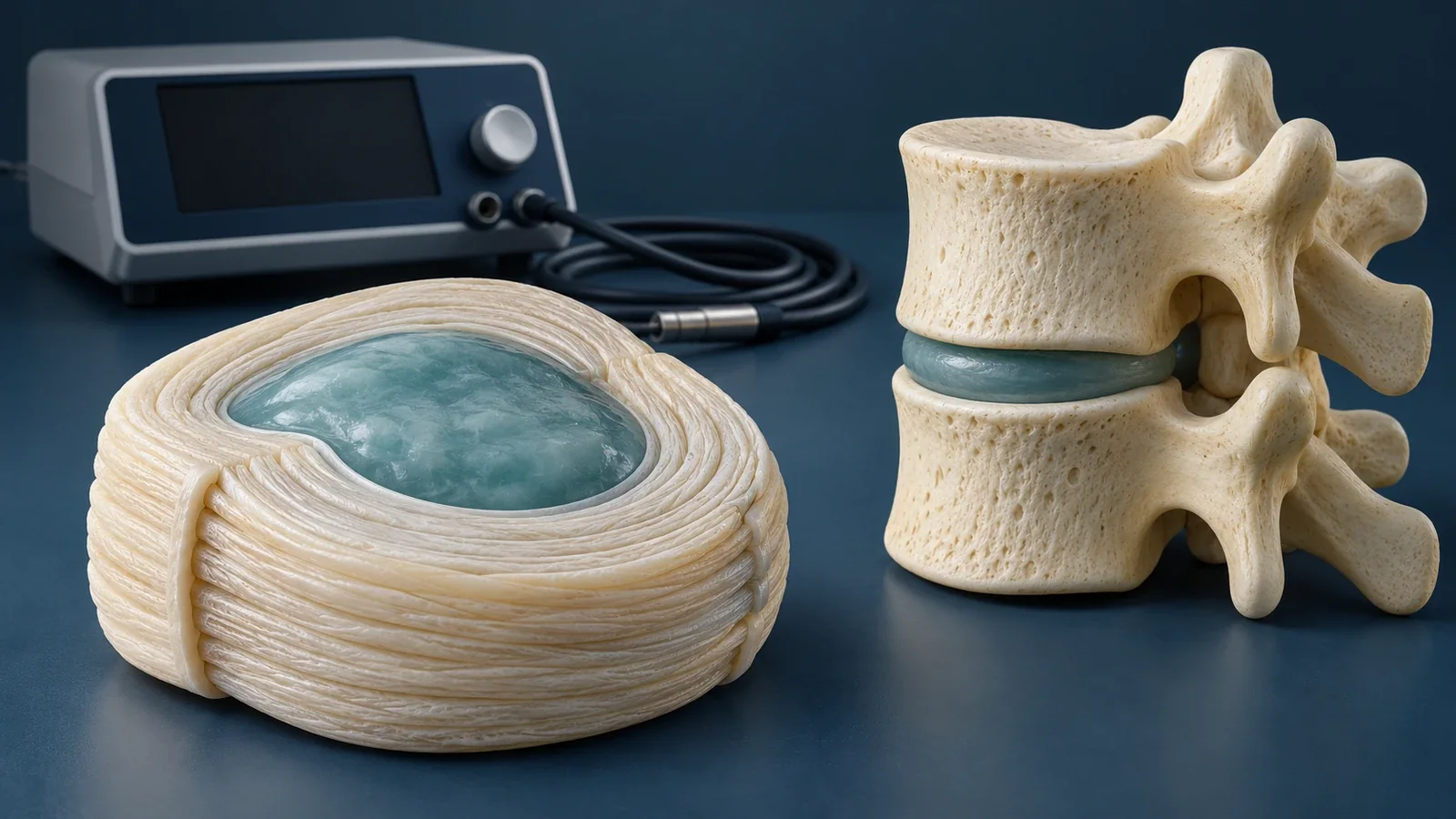
Which methods are called intradiscal procedures?
Intradiscal procedures is a general term for applications targeting different parts of a disc between vertebrae. Radiofrequency directed at the nucleus and electrothermal methods directed at the outer annulus are not the same. Devices, target tissues and studied populations may differ. This page explains the science and uncertainties, rather than stating that any method is personally necessary or should be routine.[1]
Using terms such as intradiscal treatment, keyhole herniation treatment, radiofrequency and laser interchangeably online can create false expectations. A small intervention does not establish suitability for every herniation or outcomes equivalent to surgery. Diagnosis, pain source and intended change must be clear. Limited evidence should be visible in decision discussions.
How does this differ from facet radiofrequency?
The target structure differs
Facet radiofrequency denervation targets nerve branches contributing to sensation from posterior spinal joints. Intradiscal radiofrequency concerns another anatomical structure. Research on one does not prove effectiveness of the other. Sharing an energy name does not establish clinical equivalence. Ask the exact procedure, target, rationale and alternatives. Giving consent on the basis of a broad procedure heading alone is not sufficient; the particular application and its intended purpose need to be understood.[2]
Electrothermal methods
Intradiscal electrothermal therapy, abbreviated IDET, describes an approach to the disc's outer annulus. It should not be grouped as identical to nucleus-targeting methods. It cannot be claimed to reverse every disc change or always remove nerve compression. Procedural diagrams do not explain necessity in an actual patient. Understanding which clinical problem is actually being addressed should come before being impressed by the technical appearance of a procedure or diagram.[3]
Are discogenic pain and lumbar disc herniation the same?
Discogenic pain describes pain thought to relate to a disc. Herniation describes displacement of disc tissue. Its relationship to a root is assessed alongside leg pain and neurological findings. The concepts may overlap but are not interchangeable. Degeneration on imaging alone does not confirm the pain source; asymptomatic people can have disc changes too.[4]
Knowing someone has a herniation should not lead directly to intradiscal intervention. History, examination and necessary tests assess root involvement, stenosis, joint pain and other causes. Daily function, expectations and previous approaches matter. Continuing diagnostic uncertainty should be explained before another intervention is chosen.
What does research say?
NICE guidance on percutaneous radiofrequency of the disc nucleus identifies limited quantity and quality of effectiveness evidence and emphasises special consent, outcome monitoring and clinical governance. Moving the guidance to another number in 2026 does not mean recommendations changed. It does not replace Turkish product or procedural permissions or recommend treatment for everyone.[1]
Placebo-controlled randomised IDET studies have not produced fully consistent findings. Pauza and colleagues and Freeman and colleagues reported differing results. Selection, technique and outcome measures matter. Presenting the method as superior to established care or having certain lasting benefit is inappropriate. A smaller procedure does not reduce the need for evidence.[5][6]
Relief in some people does not establish meaningful average benefit for every patient or absence of harm. Research should be read for controls, follow-up and exclusions alongside positive findings. Long-term function, additional treatment and unwanted effects matter. Effectiveness uncertainty should not be relegated to a small closing note.
How are other options assessed?
Individual information, activity adjustment, exercise and medication benefit-risk assessment may form part of back pain or sciatica care. Rehabilitation and other specialists are planned around identified problems. Investigating one intervention does not mean these approaches are ineffective. Goals can concern function and participation as well as complete pain relief.[2]
Some people with substantial herniation-related nerve compression and matching findings need surgical assessment. Microdiscectomy and endoscopic discectomy differ from intradiscal energy procedures. Explain why each option is considered. New bladder control problems, genital sensory changes or progressive weakness require prompt assessment rather than researching pain interventions.[4]
What should you ask if an intervention is proposed?
The rationale for the decision
First clarify the diagnosis, findings identifying the pain source and exact procedure name. With similar names covering different applications, target tissue matters more than device or energy labels. Discuss supporting studies, their similarity to your circumstances and long-term uncertainties. No intervention should also be considered.
Report previous surgery, clotting-affecting medicines, allergies, diabetes and infections. Do not stop blood thinners independently. Ask about monitoring facilities and contact after the procedure. Where evidence is uncertain, seek written information and alternatives rather than positive verbal descriptions alone. Research procedures should be clearly distinguished from ordinary care.
Possible risks and follow-up needs
Disc procedures may cause infection, bleeding, nerve injury or increased symptoms. Disc infection can be serious and require additional care. Thermal procedures also require consideration of surrounding tissue effects. Personal risk depends on technique and other conditions. A small skin entry does not remove complication possibilities.[3]
Follow-up assesses later function and new symptoms as well as early pain. No improvement or deterioration prompts plan review. Automatic repetition within a package should be avoided. New weakness, fever, increasingly severe pain or bladder–bowel changes require assessment. Written follow-up advice and accessible contact details matter.
How can promotional language be distinguished from clinical information?
Claims of rapid recovery or an alternative to surgery do not establish validity for everyone. Scientific information should identify the population, comparator and outcomes. Procedure footage or personal experiences do not replace controlled research. Duration of use alone does not prove benefit. Measured language therefore matters when making decisions.
Discussion should distinguish established use, research status and product permissions. A device usable for another purpose does not scientifically validate a proposed disease application. Guidance from another country does not automatically meet Turkish authority and regulatory requirements. These distinctions matter for safety and should be clear.
Seeking another opinion is a natural part of understanding alternatives. Bring previous reports and the exact proposed procedure name. If different opinions are offered, it should be explained which clinical findings each opinion relies on, so the person can understand the reasoning behind the recommendations. The goal is appropriate assessment and reasoned evidence-supported options rather than maximising intervention numbers. Monitoring treatment afterwards is just as important as making the initial decision about whether to proceed with an intervention.
Assessment of intradiscal methods in İzmir
People seeking advice about intradiscal radiofrequency, IDET or interventional lumbar disc options in İzmir should clarify terminology. Neurosurgical assessment considers pain source, neurological findings and imaging together. Share earlier tests, medicines and previous responses. Selection should extend beyond surgical versus non-surgical labels to suitability, evidence, uncertainty and personal goals.
Scientific and Institutional Sources
- NICE HTG399 — Percutaneous intradiscal radiofrequency treatment of the intervertebral disc nucleus for low back pain
Guidance; limited effectiveness evidence and special consent, governance and monitoring; not Turkish authorisation or service verification
- NICE NG59 — Low back pain and sciatica in over 16s: assessment and management
Clinical guideline; radicular pain, limits on routine injections and distinctions between medial branch blocks and radiofrequency
- NICE HTG398 — Percutaneous electrothermal treatment of the intervertebral disc annulus for low back pain and sciatica
Guidance; separate assessment of annular treatment and uncertain evidence; checked against the official overview after access problems with recommendations
- NHS — Slipped disc
Institutional patient information; lumbar disc herniation, alternatives and symptoms requiring urgent assessment
- Pauza et al. — A randomized, placebo-controlled trial of intradiscal electrothermal therapy for the treatment of discogenic low back pain
Placebo-controlled randomised trial; selected chronic discogenic pain population, not generalised to all herniations
- Freeman et al. — A randomized, double-blind, controlled trial: intradiscal electrothermal therapy versus placebo for chronic discogenic low back pain
Randomised double-blind placebo-controlled trial; negative IDET effectiveness findings and inconsistency between studies