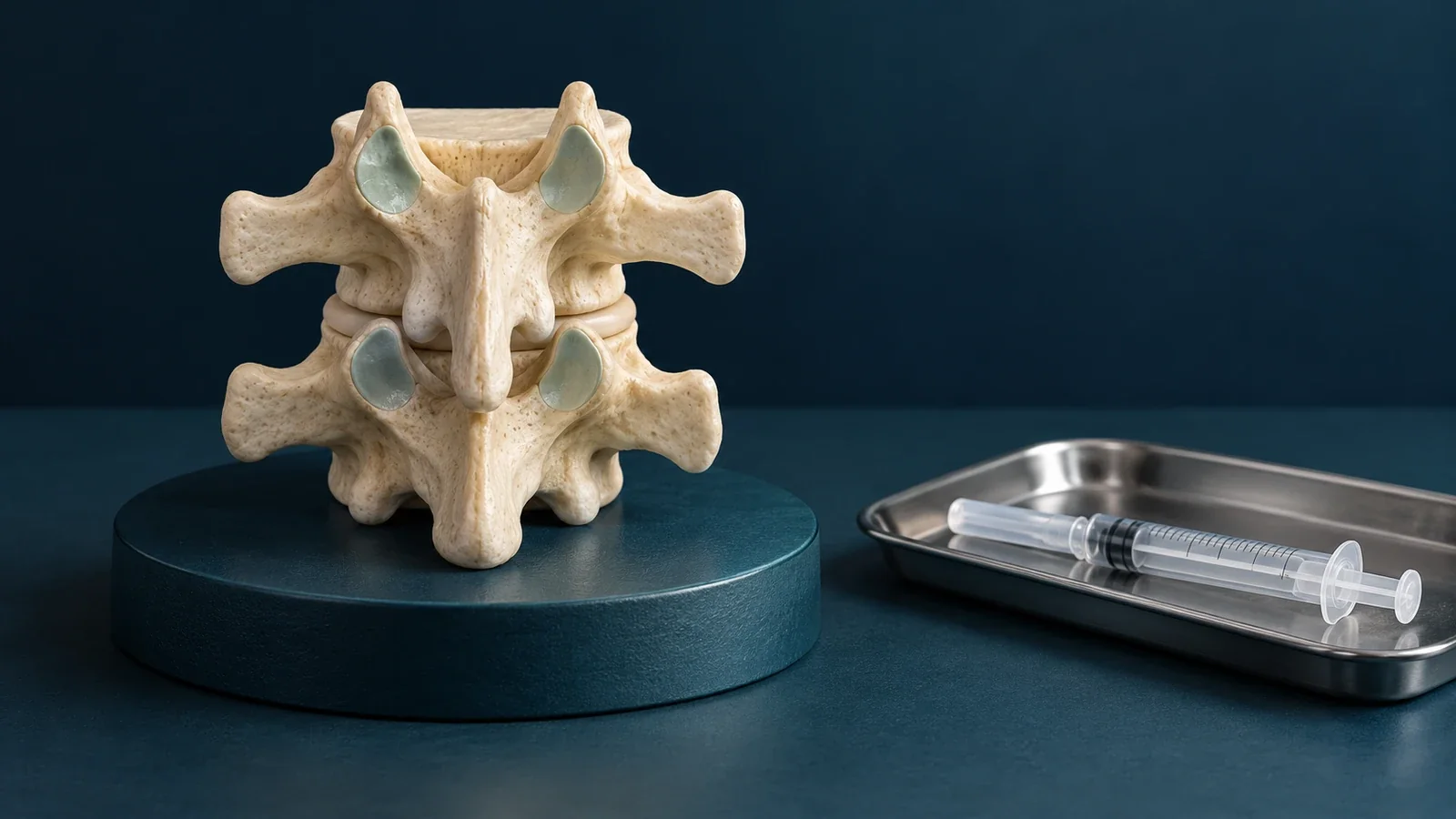
What is a facet joint injection?
A facet joint injection targets the small joints connecting adjacent vertebrae at the back of the spine. These joints help guide movement and may show age-related or other changes. Imaging changes do not necessarily establish that pain comes from them. Symptoms, examination and previous care are considered together before intervention.[1]
An injection into the joint differs from a medial branch block around the nerve carrying its sensation. Radiofrequency denervation is another procedure. Calling all of them facet blocks can cause confusion. Discussion should clarify whether the target is inside the joint or around a nerve, the injection's purpose and limitations. These distinctions are necessary for interpreting outcomes.
How is suspected facet pain assessed?
Symptoms alone are insufficient
Spinal-region pain has many causes. Muscles, discs, nerve roots and other structures may contribute in one person. Pain increasing with certain movements can suggest facet involvement without establishing a diagnosis. Joint degeneration on MRI or CT alone likewise does not explain symptoms. Clinical assessment also considers other causes.[2]
Distinguishing nerve root pain
Herniation-related root pain and regional pain thought to arise from facets are different conditions. Radiation into an arm or leg, numbness and weakness may require different investigation. Recommending facet injections to everyone reading a disc herniation page would be inappropriate. Discuss which pain component is targeted and which symptoms are unlikely to benefit.
Scientific evidence and limitations
There is no strong, universally applicable conclusion establishing long-term therapeutic effects from intra-articular facet injections. NICE does not recommend routine spinal injections for lower back pain. This does not mean all spinal procedures are the same; it separately discusses diagnostic medial branch blocks and radiofrequency assessment in selected patients.[3]
The randomised FACTS trial did not support intra-articular injections or medial branch blocks as therapeutic treatments in themselves. It also investigated their possible prognostic role before radiofrequency. Findings do not support presenting joint injection as a standard procedure providing lasting relief. An individual may experience relief, but that does not establish the same expected outcome for everyone.[4]
Decisions and alternatives
Assessment of neck and lower back pain extends beyond interventions. Activity adjustment, suitable exercise, rehabilitation and medication assessment may form part of care. Persistent pain may also prompt discussion of sleep, work and movement avoidance. Considering these does not mean pain is unreal; it helps explain all influences on function. An injection does not replace this broad assessment.[3]
If intra-articular injection is considered, explain the rationale, uncertain duration of benefit and alternatives. Choosing not to perform a procedure is also among the options that can be discussed when the treatment decision is considered. If a previous injection failed, ask why repetition is proposed. Diagnostic aims, temporary relief and assessment for another intervention should be defined separately. Repeated procedures should not follow a standard package approach.
Preparation before the procedure
Health information to share
Report medicines affecting clotting, diabetes, immune conditions, allergies and previous infections. Earlier injection medicines and adverse effects matter too. Share relevant contrast allergies if contrast may be used. Pregnancy or its possibility affects imaging choices. Do not stop medicines or change doses without medical advice.[1]
Prepare imaging reports, operative records and a current medicine list. Ask about fasting, accompaniment and transport. Sedation needs differ. During consent, ask about unclear terms and ensure you can describe the procedure's purpose in your own words. Written information is provided to support the spoken consultation and help understanding; it cannot take the place of that personal discussion.[5]
The general procedure framework
Facet interventions use suitable sterile conditions with appropriate imaging support considered. The intended intervention site is checked, skin prepared and injection performed. Medicine contents and joint level depend on individual circumstances. Lumbar, cervical and thoracic anatomy and risks differ. Information for one region should not be transferred unchanged to another.[1]
This page does not provide technical instructions; needle direction, depth and doses require professional training and clinical assessment. Report unexpected symptoms during the procedure. Observation and discharge are planned afterwards. Work, driving and exercise advice is tailored and should not be replaced with general online information.
Possible unwanted effects
Local pain, tenderness or temporary symptom increases may occur. Possible complications include bleeding, infection, allergy and nerve injury. Steroids may cause raised blood glucose, temporary flushing or skin changes. Radiation exposure should be explained where relevant to imaging. Personal risk depends on conditions, medicines, region and the plan.[5]
Repeated steroids require consideration of total exposure and potential harm alongside brief previous relief. Failure to reduce pain should not simply lead to more frequent procedures. Reassess the source and goals if expected benefit is absent. Recording baseline function makes outcomes more concrete.
Expectations and recording the response
Learn what the patient expects. If they expect every joint change to disappear, explain that this is not the method's aim. Temporary relief and structural healing are different concepts. Record daily functioning alongside pain changes. Sitting, standing up and short walks are concrete examples for review. The same goals are not selected for every person; the relevant tasks depend on the individual's own difficulties and daily needs.
A diary can record the date, baseline symptoms and subsequent changes. Additional medicines and newly started treatments also matter, helping distinguish influences where possible. The aim is clearer information at review rather than constant focus on pain. Ask which records the team needs. Unexpected new symptoms should not merely be recorded and left until the next appointment.
Ask how a proposed intra-articular injection relates to other procedures. Diagnostic block criteria differ from assessment of therapeutic injection. Discuss the next step if there is no response. Understanding other options and possible consequences of no procedure matters alongside understanding the offered intervention. This discussion is central to individual planning.
Follow-up and common questions
Is it the same as radiofrequency?
No. Intra-articular injection targets the joint; radiofrequency denervation applies energy to selected nerve branches. A diagnostic medial branch block introduces local anaesthetic around those nerves. They may be related in assessment but are not one procedure. Radiofrequency suitability, alternatives and risks require separate consideration.[2]
Which symptoms require help?
Fever, increasing redness, marked swelling, new weakness or worsening pain require medical assessment. At discharge, learn what may be expected and whom to contact. Assessment for a facet joint injection in İzmir should consider all possible causes of neck or back pain. Neurosurgical consultation connects disease, pain mechanisms and options appropriately for the individual.
Scientific and Institutional Sources
- Guy’s and St Thomas’ NHS — Facet joint injections for treating pain
Institutional patient information; joint injection, procedure and follow-up; benefit statements considered within guideline and trial limitations
- Cohen et al. — Consensus practice guidelines on interventions for lumbar facet joint pain
Multispecialty consensus guideline; diagnostic and prognostic blocks and limitations of response interpretation
- NICE NG59 — Low back pain and sciatica in over 16s: assessment and management
Clinical guideline; radicular pain, limits on routine injections and distinctions between medial branch blocks and radiofrequency
- Cohen et al. — Effectiveness of Lumbar Facet Joint Blocks and Predictive Value before Radiofrequency Denervation: FACTS
Randomised controlled trial; findings do not support blocks as lasting treatment; prognostic assessment
- The Dudley Group NHS — Facet joint injections and medial branch block
Institutional patient information; distinguishing procedures, safety and preparation; non-individual fasting instructions not reproduced